

render Benthem Crouwel architects
Student: Jonas M.A. Chenderasa
Supervisors: Arjan Habraken, Emanuela Bosco, Roy Crielaard
07-05-2026
Abstract
Engineered bamboo offers a fast-growing bio-based structural alternative to softwood, but Eurocode 5 (EC5) does not cover laminated bamboo lumber (LBL), so projects in Europe currently require special project approvals that make LBL implementation difficult and limit its carbon storage potential. Bamboo can be harvested for structural use after only 4-5 years, sequestering CO2 on each cycle. One specific gap in EC5 is the splitting check for dowel-type connections loaded perpendicular to the grain. These checks are needed to design structural connections and dowels are one of the most common fastener type. Closing that gap means calibrating the existing splitting equations against LBL test data so the code can be applied without a special approval each time.
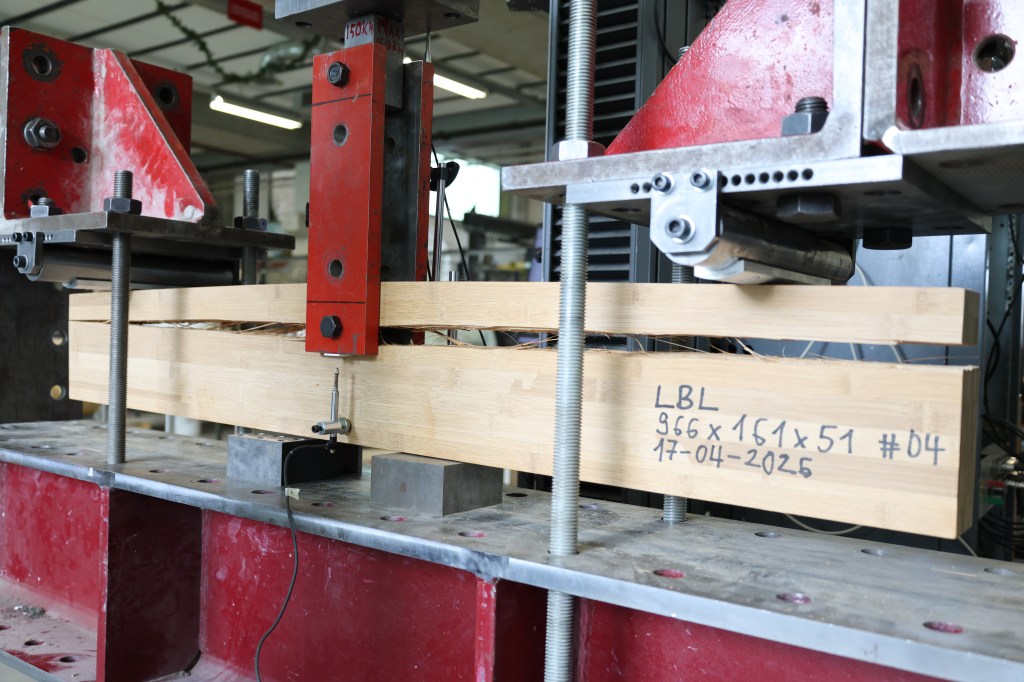
Specifically, this thesis tests whether EC5 Gen 1 eq. 8.4 and EC5 Gen 2 eq. 11.54 are applicable to LBL dowel connections, and if so calibrates their parameters. Three lines of evidence are used: small-scale fracture tests (SENB for Mode I and ENF for Mode II), full-scale splitting tests on two beam geometries (flatwise and edgewise), and a finite-element simulation in LS-DYNA with prescribed cohesive crack paths. A literature review of LBL mechanical and fracture properties underpin the experimental and numerical results.
EC5 Gen 1 section 8.1.4 can be applied to LBL without modification based on the conducted tests. The full-scale splitting tests return a CLBL,k ≈ 14.4 N/mm1.5, within 3% of the softwood value Ck = 14. The results calculated from SENB values returns CLBL,k ≈ 17.9. Both results are inside a 14-19 N/mm1.5 range comparable to softwood timber. EC5 Gen 2eq. 11.54 needs a new material factor kmat for LBL. This thesis proposes kmat,LBL = 0.7 (exact result is 0.779, rounded down conservatively), which is between sawn timber (0.6) and panels / LVL-P (0.8). The calibration only adjusts the material factor kmat and leaves the density factor kG untouched.
These results show that LBL is not more resistant to splitting compared to softwood timber, despite its higher density and the GIC values found in the literature would suggest so. Both calibrations are not definitive results yet as they were done at only a n = 4 per-section sample size and single α value (edge distance to height ratio).
Other takeaways from this research are that the section build-up is important both for the experimental fracture results, as well as in turn the calibrated parameters. The flatwise section build-up returns ≈ 46% higher splitting capacity than edgewise across both EC5 generations and across the SENB and ENF small-scale tests. This means the flatwise orientation should be the default for dowel connections loaded perpendicular to the grain. Furthermore, test have shown that splitting failure is Mode I dominated, with intra-lamella fibre delamination and no glue-line separation observed in any test.
Keywords: Bamboo structures, Bio-based materials, Eurocode 5, Laminated bamboo lumber (LBL)
Cite this
Splitting of Laminated Bamboo Lumber Connections Loaded Perpendicular to the Grain
Chenderasa, J. M. A. 07-05-2026
