

Student: Edwin E.C.L. van Houte
Supervisors: Arjan Habraken, Faas Moonen, Susanne Bron – van der Jagt
04-11-2024
Abstract
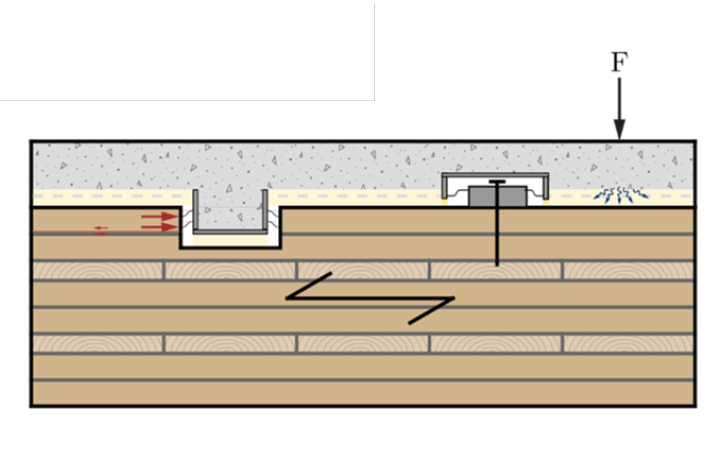
This master’s thesis explores an innovative approach to enhance the vibro-acoustical performance of CLT–Concrete Composite (CCC) floors by integrating a resilient layer between the CLT and concrete. While CCC have caught the eye of researches and the industry due to its structural efficiency, transverse stiffness and favourable vibro-acoustical properties compared to timber floor and reduced environmental impact relative to concrete floors, it cross-section often still needs to be increased or an floating floor added to reach the desirable criteria for tactile structural vibrations and sound transmission, especially in long-span residential context.
The research aims to improve vibro-acoustic performance while maintaining structural integrity through the integration of a resilient interlayer between that adds damping and decouples the system acoustically. A comparative study of various connection types, including steel mesh, screw fasteners, and notches, and their improved versions was conducted, with resilient notch connections showing the most promise. This study further investigated the floor performance by evaluating and comparing three types of floors: traditional, decoupled, and a conceptual floor featuring the resilient notch connectors.
Results indicate that although a significant reduction in connection stiffness for the conceptual floor was found, the bending stiffness was only reduced by approximately 10% relative to the traditional floor. While for the vibration performance there were positive indications for an improvement, such as an increase in damping ratio of 4.2% compared to 2.9% in traditional floors, further investigations are required to show the significance of the improvement. The acoustic results indicate that the conceptual CCC floors provide improved potential acoustic performance, particularly in mid to high-frequency ranges, due to effective decoupling and increased damping. However, further research is required in the critical low-frequency range to provide further improvements.
In conclusion, resilient notch connections can significantly improve the governing acoustic insulation of CCC floors without increasing floor height, but reaching the criteria remains a challenge. The findings offer potential for reduced material use and enhanced sustainability in multi-residential buildings, though further investigations are necessary to address dynamic issues fully.
Keywords: Timber-Concrete composite, TCC, CLT-Concrete Composite, CCC, notches, acoustics, vibrations, damping, decoupling, resilience, floating floor, sound transmission, acoustic insulation.
Cite this
The design of a composite connector detail of a simply supported long-span CLT-Concrete Composite floor, to improve vibro-acoustical performance while maintaining its structural composite interaction.
Van Houte, E.C.L. (Author). 04-11-2024
