

Student: Lotte P.J. Krijnen
Supervisors: Arjan Habraken, Faas Moonen, Matthew Ferguson
27-06-2023
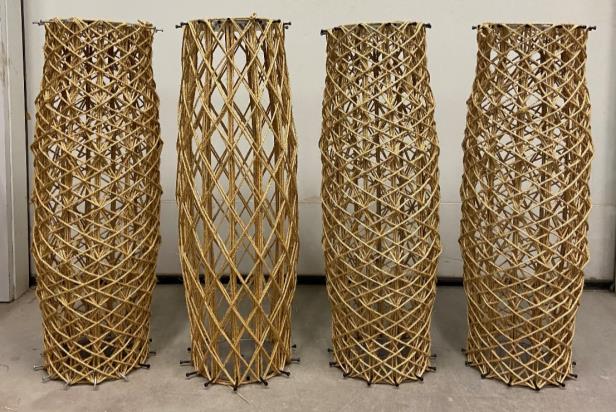
The presented work investigates the application of resin-impregnated biobased sisal rope for structural purposes. A simply supported lightweight structural element was designed to be loaded in axial compression. The element was numerically optimized to maximize buckling resistance and minimize mass and internal elastic energy. The optimized design was manufactured through robotic filament winding using biobased sisal rope, impregnated with SR InfuGreen 810 / SD 8824 epoxy resin. Robotic filament winding with bio-based materials provides opportunities for the built environment to create innovative structural elements in a fully digitized manufacturing process. Moreover, the combination of numerical optimization, innovative structural design and robotic filament winding with bio-based materials, allows to design and manufacture lightweight structures with a large degree of freedom. This can result in reduced environmental pollution caused by the traditional design and manufacturing processes of the construction sector. The manufactured fibre composite columns were after curing tested in axial compression, which resulted in a maximum compressive strength of 21.4 kN. Although the structural behaviour of the fibre composite columns was promising, further research should be conducted to conclude whether robotic filament winding with resin-impregnated sisal rope is suitable for large-scale structural purposes.
Keywords: Optimization, lightweight structures, parametric engineering, robotic filament winding, sisal fibre, biobased, axial compression, innovative structural design
Cite this
Numerical optimization and manufacturing of a bio-based 3D structure through robotic filament winding
Krijnen, L. P. J. (Author). 27 Jun 2023
 RESED
RESED 