

Student: Mees Fabel
Supervisors: Arjan Habraken, Akke Suiker, Nischal Pradhan
13-02-2026
Abstract
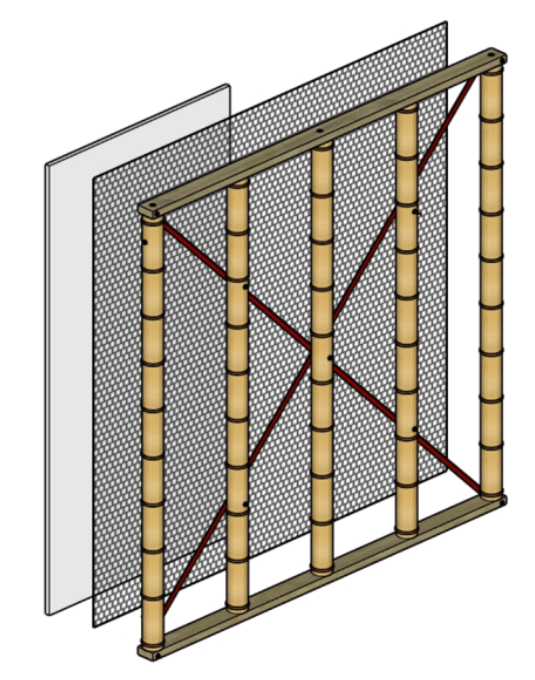
Composite Bamboo Shear Walls (CBSWs) are a promising alternative to conventional
shear wall systems in tropical regions where bamboo is abundant. However, the structural
behavior and design capacity are not yet well established. This thesis investigates
the predictability of horizontal shear capacity of CBSW by comparing outcomes
of experimental testing and analytical modeling. Two configurations of 2.4 × 2.4m wall
panels were subjected to monotonic and cyclic in-plane loading to characterize global
force–displacement behavior and failure mechanisms. In parallel, single-fastener tests
were conducted to quantify the nonlinear behavior of these fasteners.
An analytical model was developed to predict the horizontal shear capacity of CBSW
by explicitly incorporating nonlinear fastener behavior and wall geometry. The model
successfully captures the relative influence of fastener type, quantity, and position, as
well as the effect of flat bar bracing, and shows good agreement with experimental results,
with deviations generally within 10–20%. The model slightly overestimates elastic
stiffness and underestimates peak capacity, primarily due to simplifying assumptions
regarding component rigidity.
Analysis of force distribution reveals that corner fasteners dominate shear resistance,
while central fasteners contribute minimally, providing clear opportunities for structural
optimization. Several improvement strategies were explored using the model, including
wall reconfiguration, altered embedment conditions, and enhanced fastener properties.
The results demonstrate that targeted design modifications can significantly
increase shear capacity and stiffness. Finally, comparison with current design values
shows that existing shear capacity provisions are highly conservative, underestimating
CBSW capacity by at least a factor of 2.8.
Overall, this research validates an analytical framework for CBSW design, provides insight
into governing mechanisms and failure modes, and demonstrates the potential
for more efficient, reliable, and sustainable structural applications of bamboo-based
shear wall systems.
Cite this
Fabel, M. (2026). Development of an analytical model predicting the horizontal shear capacity of Composite Bamboo Shear Walls [Thesis]. In Eindhoven University of Technology. Eindhoven University of Technology.
 RESED
RESED 