

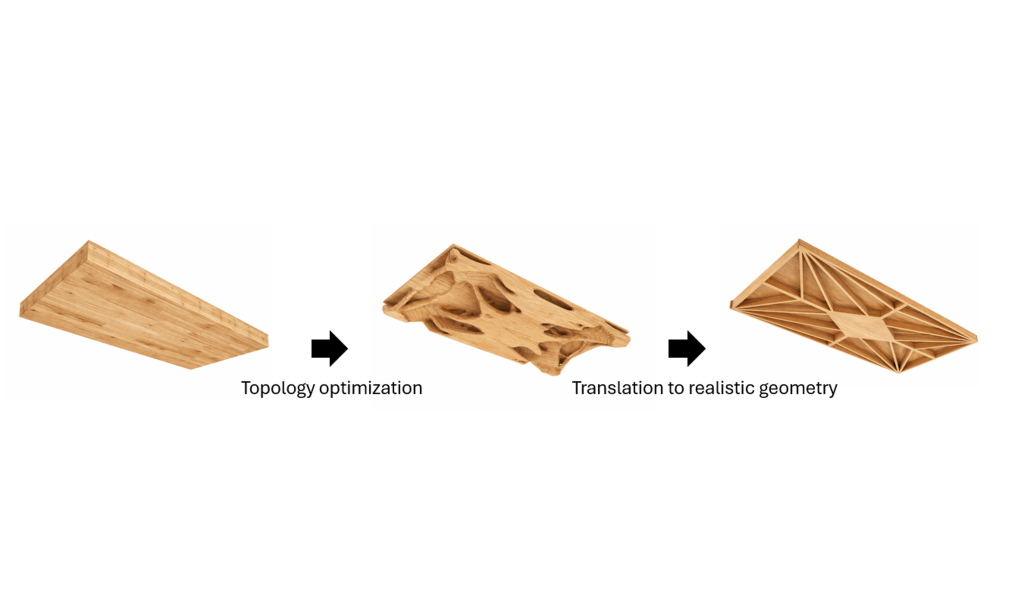
Topology optimization applied to floor slabs constructed in timber
Student: Cas Gansner
Supervisors : Arjan Habraken, Vincent Staat
Structural engineering stands at the core of the construction industry, with design and material decisions made by structural engineers heavily influencing the material consumption of construction projects. A very clear example of this is found in floor slabs. As outlined by Block et al (2019), floor slabs take up a total of 40% of a building’s mass. This is a clear indication that, to meet future housing demands sustainably, structural engineers must innovate and optimize slab systems, aligning construction practices with global climate targets.
Rethinking the design of structural floor slabs involves more than only selecting more sustainable materials, it also requires a reconsideration of geometry and structural form. Traditional slab systems are often based on flat, uniform geometries that are easy to design and construct but inefficient in terms of material use. Even though switching from traditional construction materials for slabs, such as reinforced concrete, to more innovative solutions, such as cross-laminated-timber already drastically decreases the embodied carbon (Oh et al, 2019), there are other possibilities to further reduce the environmental impact. By exploring more efficient geometries, engineers can significantly reduce the amount of material required while maintaining or even improving structural performance. Tools like topology optimization and parametric design allow for the creation of structurally efficient forms that place material only where it is needed, reducing the total material usage in construction.
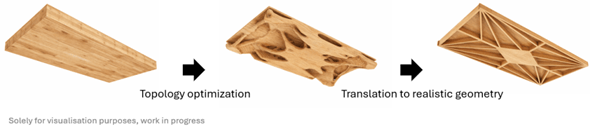
The translation from a topology optimized geometry to a realistic make-able product includes great complexity, and will be the main focus of this research. This includes finding an algorithm to translate the complex geometry into straight lines, as well as FEM analyses and connection design.
References
[1] Wang, Q., Senatore, G., Jansen, K., Habraken, A. P. H. W., & Teuffel, P. (2022). Multi-scale experimental testing on variable stiffness and damping components for semi-active structural control. Composite Structures, 281, Article 114976. https://doi.org/10.1016/j.compstruct.2021.114976
Block, P., Barentin, C.B., Ranaudo, F., N. (2019). Imposing Challenges, Disruptive Changes: Rethinking the Floor Slab.
Oh, J., Park, K., Kim, Hy., Kim, I., Pang, S., Ahn, K., Oh, J. (2023). Comparative CO2 Emissions of Concrete and Timber Slabs with Equivalent Structural Performance. Energy and Buildings. 28110.1016/j.enbuild.2022.112768.6.
 RESED
RESED 