

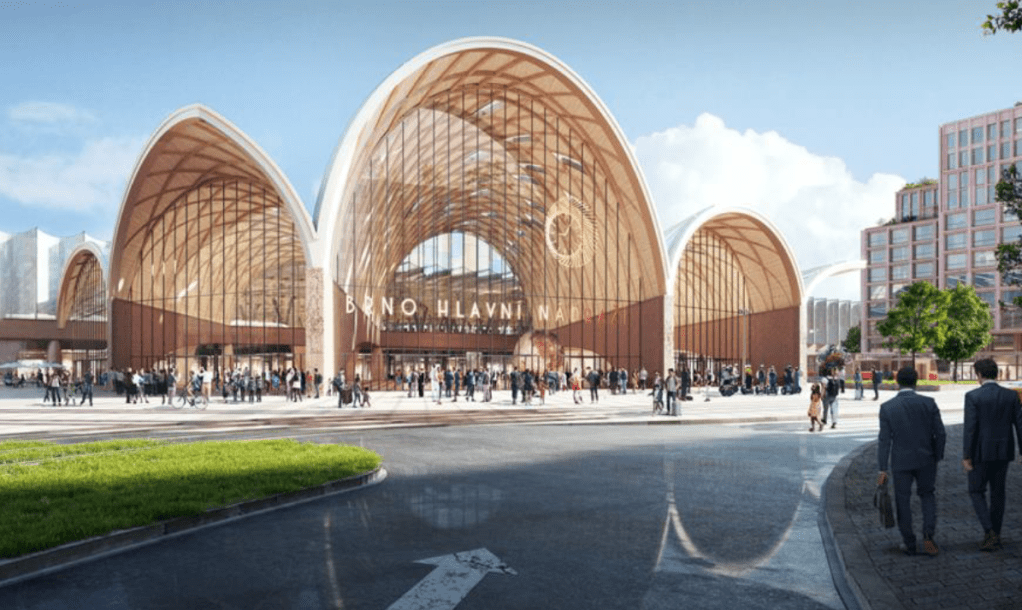
render Benthem Crouwel architects
Student: Job Niessen
Supervisors: Arjan Habraken, Faas Moonen, Karsten Nefs
12-05-2023
Abstract
TThe city of Brno is set to receive a new main train station designed by Benthem Crouwel Architects. The entrance hall of the station consists of five barrel vault-shaped segments which have a timber grid roof structure. This project is focussed on the structural design of the timber grid structure of the entrance hall’s roof. Multiple design options such as the arch shape, grid pattern, support conditions, barrel vault variants and different connections are analysed.
For long-spanning structures, the own weight of the structure may become determining for the cross-section’s dimensions. However, timber is a lightweight material which means it may be more vulnerable for effects due to snow and wind. It was discovered that the largest bending moments in the structure are caused by wind, for which a parabolic shape is favourable over the catenary line and ellipse.
that defines the structures shape. This grid pattern can be shifted resulting in the elements being connected differently at the supports. Next to that can the base surface be divided into equal parts. The latter was found to result in slightly lower internal forces than the other grid patterns.
Different support conditions such as hinged, semi-rigid and rigid are analysed. Next to that, the combination of hinged supports at one side and rigid at the other side is considered. Semi-rigid supports, which can be created by connecting the adjacent arches, results in the lowest bending moment in the structure. In addition, it significantly reduces the deformation of the structure and increases the stability compared to hinged supports.
The barrel vault shaped segments depicted in the architectural design have a single-curved monoclastic shape. Applying a second curvature by creating a height difference along the vault will result in a saddle-like shape (anticlastic) or dome-like shape (synclastic). The double curvature may lead to more stiffness to the structure. Another possibility is incorporating the facades in the structural system. This will restrain the structure from the sideways movement caused by wind. It was found that the facades and the anticlastic shape will both reduce the deformations and maximum bending moment. The restraining of the facades will however result in significantly larger normal forces.
Three joint mechanisms are considered to be interesting for the timber grid structure. A segmented system in which the elements span from node to node, a lattice system in which the elements more or less have a woven structure and considering the structure to exist from individual arches with secondary beams in between. Because the secondary beams have hinged ends they only experience normal forces. The different joint mechanisms are compared to each other, first on their structural behaviour. Then a variant study is conducted in which their complexity in the manufacturing process and their potential material cost is analysed. The elements in the two different directions do not experience an equal magnitude of the internal forces. Therefore it is expected that considering the structure as individual arches with secondary beams leads to a design that requires the least amount of timber. Furthermore is it considered to be a relatively practical variant to realise. In the lattice system the elements are build-up from different layers with shear blocks, and twist along their length. The segmented system requires a relatively large amount of steel because each node exists from long steel slice plates with many bolts and a long steel tube to which the slice plates are connected
A vertical load on an arch causes horizontal reaction forces at the supports. Because the roof is supported by a long-spanning structure, the supports are not restrained from moving horizontally. The beam of the long-spanning structure can however be used to create a truss-like structure and preventing the supports from moving horizontally. To obtain this truss effect, the supports in the corners of the roof need to be restrained from horizontal movement by the use of for example the facades or tie rods.
Based on the results from the analysis conducted during the project, a final structural system was chosen for which the detailing is worked out. The structure has an anticlastic shape, a catenary shape for the arches, semi-rigid supports and a grid pattern created by dividing the base surface into equal parts. Furthermore is the structure considered to exist from individual primary arches with secondary beams in between. The detailing includes the supports, connections between the segments of the arches and the connections of the secondary beams to the arches. A criterium for the maximum allowable horizontal deformation was mostly determining for the final appearance and properties of the structure..
Keywords: Timber structures, BRNO, BCA, Arch structures
Cite this
Feasibility study towards a timber structural design for the entrance station hall of BRNO.
Niessen, J. 12-05-2023
 RESED
RESED 