
Student : Tomas Hermsen
Supervisor : Arjan Habraken, Faas Moonen, Gart-Jan Rozemeijer
Introduction
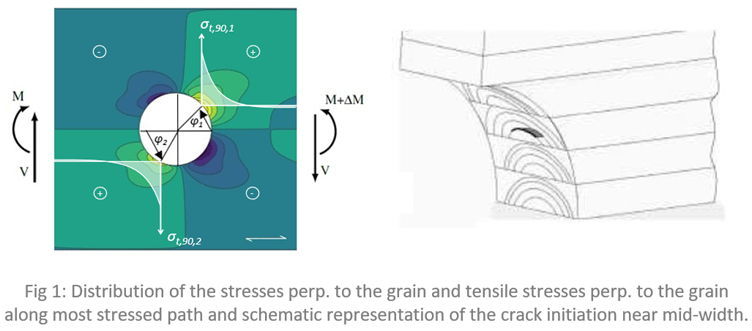
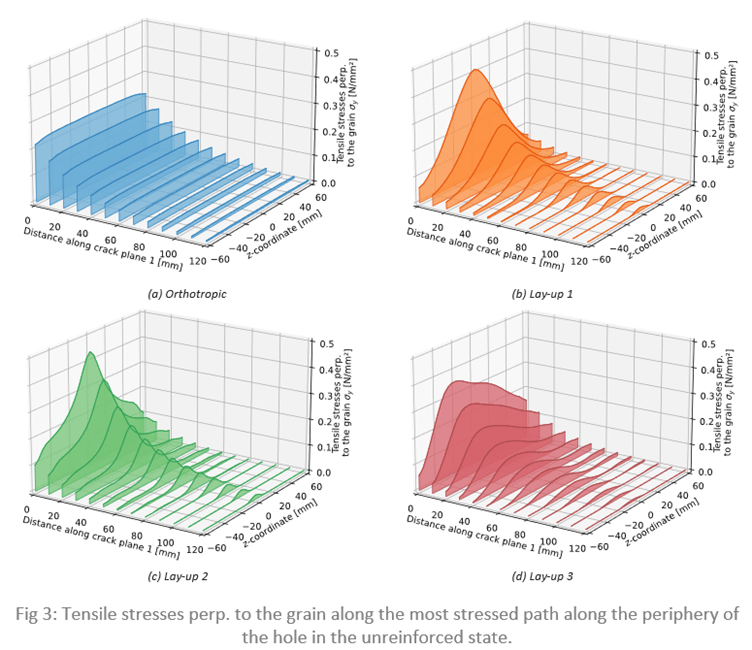
Introducing a hole in a glulam beam leads to the redistribution of the shear and bending stresses in the vicinity of the hole. As a result, stress concentrations occur along the periphery of which the tensile stresses perp. to the grain are of particular interest since timber has the lowest resistance against these stresses. The failure mechanism of unreinforced and reinforced holes is well known. It involves crack propagation in the direction along the grain in two diagonally opposed quadrants starting at the location where the tensile stresses perp. to the grain reaches its maximum. Experimental tests in the literature reported that the cracks always initiated near the mid-width of the cross-section. This was attributed to the cylindrical anisotropy of wood, which leads to an inhomogeneous stress distribution along the width with a pronounced stress peak near mid-width.
Therefore, this graduation project aimed to study the influence of the cylindrical anisotropy of wood on the stress distribution in the vicinity of an unreinforced and reinforced hole.
Cylindrical anisotropy of wood
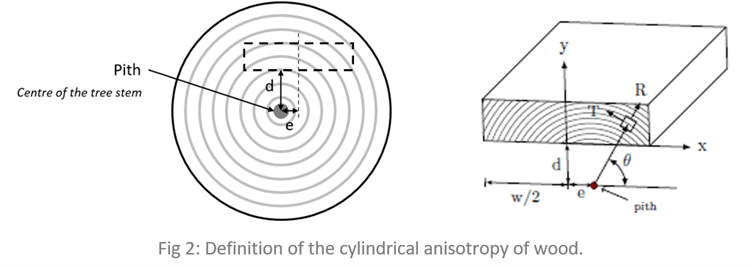
Timber is usually regarded as an orthotropic material where only a distinction is made between the parallel and perpendicular to the grain direction. However, this gives an inadequate representation of the stresses perp. to the grain. A better representation would be considering the cylindrical anisotropy of wood. This representation considers the annual ring pattern present in the laminations and considers the three different principal directions: the longitudinal, radial and tangential directions. This cylindrical orientation and the difference between the radial and tangential direction are responsible for the inhomogeneous stress distribution and the pronounced stress peak. The centre of the cylindrical orientation is marked by the pith of the tree stem from which the lamination was sawn.
Methodology
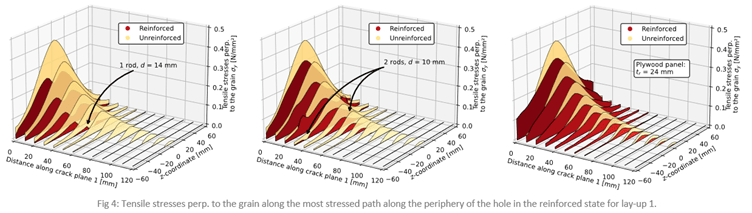
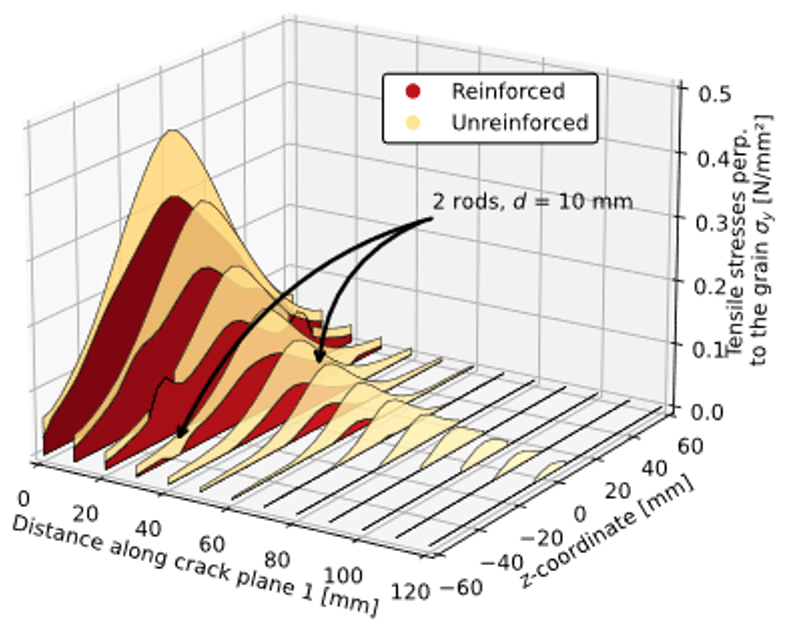
In order to study the effect of the cylindrical anisotropy of wood on the stress distribution four cases were regarded: an orthotropic reference case and three cylindrical anisotropic cases with a different lay-up pattern for each case. The three lay-up patterns are characterized by a constant pith distance d, a jumping pith distance d, and a periodically varying eccentricity e of the pith. For all four cases, a circular hole with a diameter of 0.3h placed along the neutral axis of the beam was assessed. Furthermore, three different reinforcement scenarios were investigated: a single rod with a diameter of 14 mm, two rods with a diameter of 10 mm and a plywood panel with a thickness of 24 mm installed at both sides of the glulam. The rods were installed at an angle of 45°.
Results
It was observed that considering the cylindrical anisotropy of wood leads to an inhomogeneous distribution of the tensile stresses perp. to the grain with pronounced stress peaks near the mid-width. These peaks could reach values of 1.5 (lay-up 3 with a periodically varying eccentricity of the pith) to 1.9 (lay-up 2 with a jumping pith distance) times the maximum value of the orthotropic reference case. A single rod installed at an angle of 45° was the most effective in reducing the tensile stress peaks with reductions of 30% to 48%. Conversely, the plywood panels were the least effective in reducing the tensile stress peaks, with a reduction of 22%.