

Student: Max M.J. de Munnik
Supervisors: Arjan Habraken, Faas Moonen, Tom Godthelp
23-05-2023
Abstract
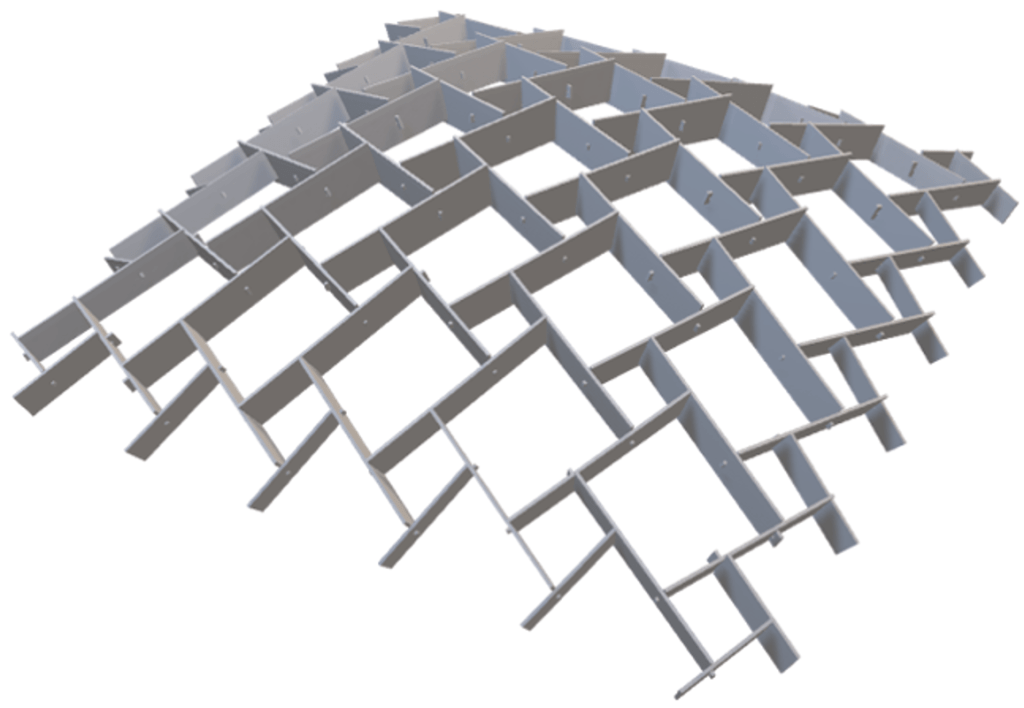
To reduce environmental impact, structures should be made from environmentally friendly material and the waste of material during production should be minimized. Plywood reciprocal frames can potentially offer a solution that exploits the fact that relatively short members are used in reciprocal structures. This namely offers the opportunity for sustainable construction because it allows structural elements to be retrieved from standardized plywood products. Prior research on reciprocal structures has not adequately addressed the structural optimization of individual elements in reciprocal structures. Additionally, there has not been any focus on the minimization of waste material. In order to tackle those untapped areas of research, a reciprocal frame design tool has been developed that can generatively design a reciprocal structure based on a set of parameters and optimize the cross sections to be able to sustain Eurocode loading and fulfill Eurocode 5 unity checks.
The reciprocal frames are generatively designed by applying the center-to-center method (controlled by the scale factor parameter) on a two-dimensional tessellation. The tessellation mainly decides what the resulting structure looks like and is controlled by a set of parameters (base size, pattern type, edge size and density gradient). The resulting two-dimensional reciprocal frame is then inflated to a three-dimensional structure by moving the z-coordinates of the beam nodes. The correct geometry is found by mathematically minimizing the geometric ‘error’ by using the L-BFGS-B algorithm, that performs a directed search for the optimal solution. After the geometry is found, the individual sections are optimized using a custom by-part optimization process.
How the resulting geometry can be obtained as efficiently as possible from the (standard) plywood sheets is determined by (a) bin-packing algorithm(s). As a result, the number of sheets required to produce the structure is known. Therefore, the reciprocal frame designer can be seen as a black-box function with the design parameters as input and the number of sheets as output. This black-box function is used to optimize the initial set of design parameters. Firstly, an initial exploration has been performed to find the areas of interest. The resulting area of interest is often a tessellation edge size where two rows of beam elements can be obtained from one sheet. Within this area of interest, the set of parameters resulting in the least amount of plywood sheets is deemed the optimal reciprocal frame.
There are multiple layouts for each tessellation pattern that result in the lowest amount of plywood sheets. Generally, the smaller the scale factor, the more optimal the structure. The most optimal tessellation patterns are the triangle pattern and the square pattern. The other patterns are less efficient due to the inconsistent beam lengths or the relatively large beam lengths resulting from the tessellation geometry.
Keywords: Reciprocal frame, structural optimization, plywood, sheet material, parametric optimization, waste-material, innovative structural design, digital fabrication
Cite this
Generatively design and digitally fabricate of optimized three-dimensional reciprocal frame structures
Munnik, M.J.. (Author). 25-05-2023
