
Student : Elise Wielinga
Supervisor : Arjan Habraken, Akke Suiker, Gart-Jan Rozemeijer
Introduction
The popularity of timber as building material has intensified due to growing awareness for sustainability of building constructions and demand for prefabricated solutions. Interlocking timber joinery might offer a revival due to recent innovations in digital production such as Computer Numerical Control. Application to conventional buildings could offer a solution to quicker, more sustainable and demountable construction on a large scale. The goal of this research was to investigate what the optimal design parameters are to maximize the tension and shear strength of interlocking timber joinery in plywood diaphragm floor seams.
Variation study
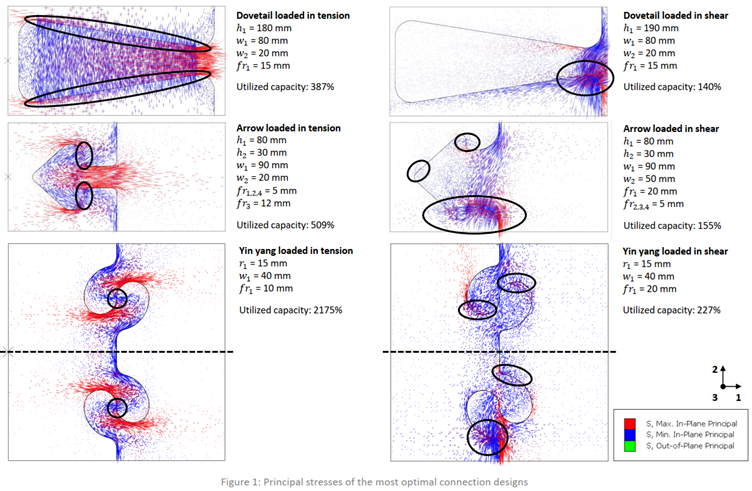
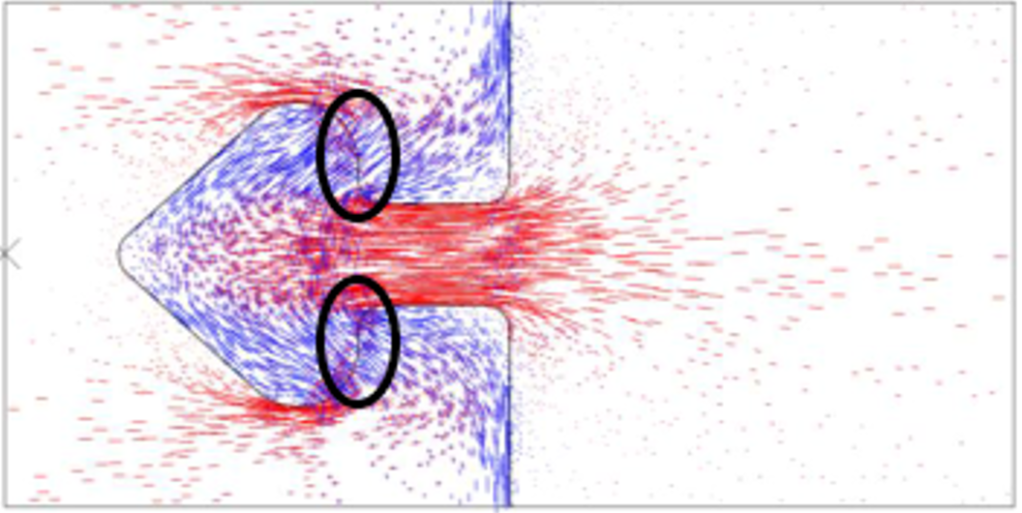
Linear Elastic Finite Element Analyses were performed to analyse the influence of the shape of timber connections on their tension and shear strength capacity. Dovetail, arrow and yin yang shaped connections with varying geometric parameters were investigated. Their height, width, radii and fillet radii were varied. Parametric scripts were used for automated creation of the Finite Element Models and post-processing of the results. The strength optimization study was performed by applying two failure criteria, where the peak or average stresses were assessed to the design strength of 18 mm thick spruce plywood. The most optimal designs per connection shape are presented in Figure 1. The most important factor was the contact pressure area (marked by the black circles). When a large area can be utilized for contact pressure, peak stresses were generally lower. Moreover, rounded corners (i.e. larger fillet radii) reduced the peak stresses.
The given values for the utilized capacities in Figure 1 should be interpreted as a comparison rather than an exact number. It can be noticed that the tension load is substantially more critical than the shear load. A dovetail design had the most optimal configuration for the tension load. The pressure contact area increased when increasing the height parameter ℎ1. Large fillet radii 𝑓𝑟1 reduced the peak stresses at the corners. However, the connection becomes prone to sliding when applying a large fillet radius in combination with a large neck width 𝑤2 . Tension stress parallel (direction 1) was the governing stress for most tension load designs. The direction of the compression at pressure contact areas influence the strength capacity as well. Compression was directed in the weakest direction for the dovetail and in the strongest direction for the arrow and yin yang in Figure 1. This explains why the difference between the dovetail and arrow capacity is relatively small compared to the pressure contact area. The yin yang is prone to sliding and has an extremely small pressure contact area.