
Student: Franka Pels Rijcken
Supervisors : Arjan Habraken, Faas Moonen, Vincent Staat
Introduction
The Dutch building industry is experiencing considerable pressure from the government to reduce its CO2 emissions. This goal can be achieved by reducing raw material usage, maximising the use of renewable resources and minimising the material usage during the whole lifecycle of a building. These approaches were explored in this study by digitally designing and fabricating a structural beam using a new bio-based material, and additive manufacturing (AM) was utilised to produce this beam.
Bio-based printable mixture
To create a printable mixture, one can combine a raw material, a binder, and a liquid. The ingredients must be thoroughly mixed until a homogeneous mixture is achieved, after which additives can be added (Fig. 1). The mixture should be fluid enough to be extruded but solid enough to support its own weight and shape. Furthermore, it should exhibit sufficient adhesion to itself to form a bond during the curing process.


Parametric design
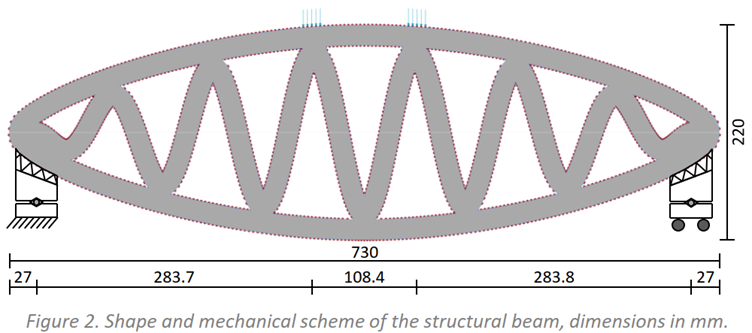
The structural beam was designed using Grasshopper and numerically calculated in GSA. It was designed as a variation of a truss: it consisted of a top and bottom chord and diagonals (Fig. 2). The design process was executed in several steps. First, the outer shape was designed and followed by the inner shape. After that, the dimensions were structurally optimised using Galapagos in Grasshopper.
.
Robotic printing
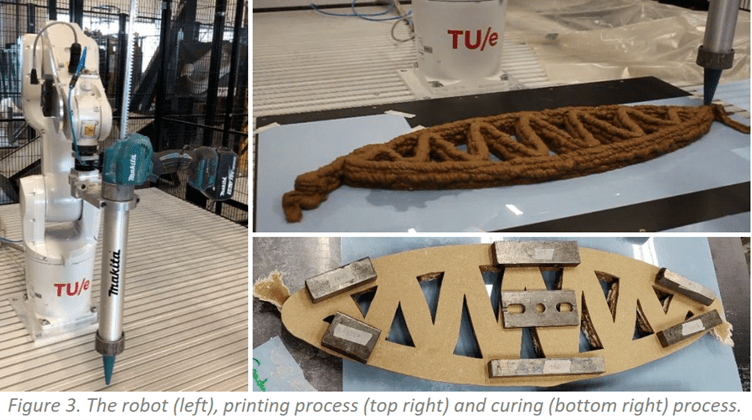
Once the design was finalised, the beam was printed. The print path was carefully designed in Grasshopper, using the RobotComponents plugin, and subsequently tested in Robot Studio. The robot used in this project was the ABB IRB 1200-5/0.9 robot, which was equipped with a Makita caulk gun as the extruder. After printing the six layers of the beam, the element was placed inside the climate room to cure for 40 days. During the final 17 days, small weights were added on top of the element to prevent warping (Fig. 3).
Testing
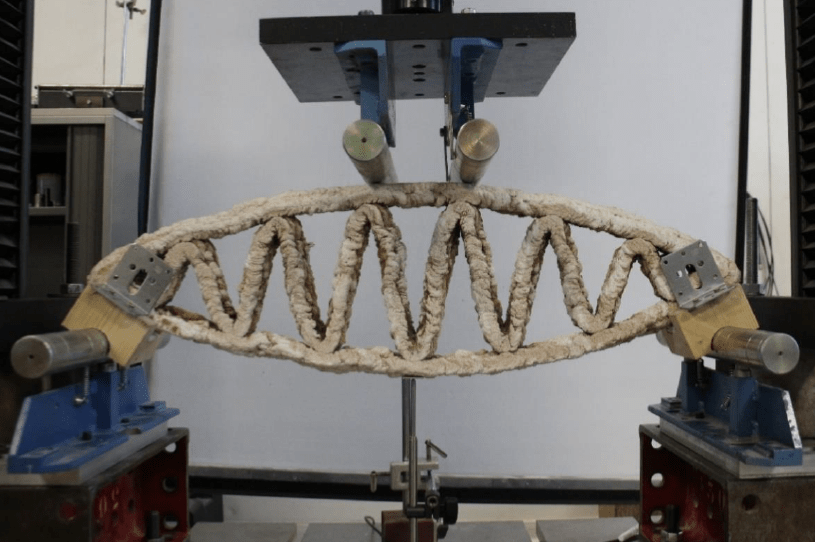
The cured beam was placed in the Instron electromechanical universal testing machine (Fig. 4.1) and subjected to a flexural test. Initially, a peak force of 1.65 kN was reached, which slightly exceeded the calculated force of the numerical model (1.63 kN). Thereafter, the beam behaved different than expected: a wave disconnected from the top chord (Fig. 4.2) and following a redistribution of stresses, the bottom chord broke next to the second valley (Fig. 4.3).
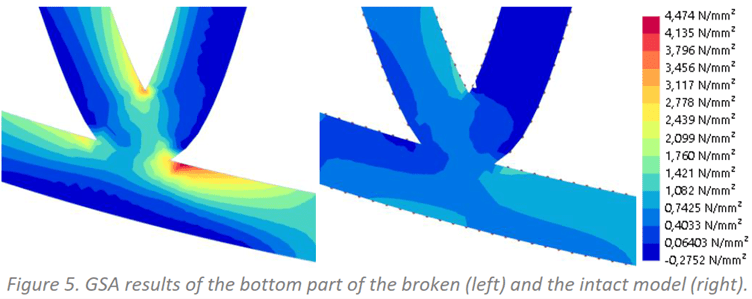
After a numerical verification in GSA was performed with a model having no connection between the second wave and the top chord. It became evident that this disconnection caused the tensile stresses in the fracture location to be significantly higher compared to the model which was intact (Fig. 5). This “broken model” confirmed the behaviour of the beam during the test, thereby revealing the importance of a good connection between different paths. Thus, it was concluded that it is possible to produce a digitally designed structural beam using AM with a newly developed 100% bio-based material. The mechanical properties of this material are comparable to those of other low-strengths materials. However, further development of the material is required before its use in building applications can be considered: