Mass Optimization of Vibration Sensitive Hollow Timber Floors
Student : Dylan van Mullekom
Supervisor : Arjan Habraken
Mass Optimization of Lightweight Hollow Timber Floors
The use of lightweight timber floor systems is becoming more apparent as the built environment is shifting towards a more sustainable and circular construction industry. Their ease of prefabrication, low environmental impact, and potential for long-span designs make them an attractive alternative to conventional floor systems. However, their low self-weight also makes them more susceptible to human-induced vibrations that can negatively affect an occupant’s comfort.
The foundation of this research lies in the work of T. Goor, which explored how the placement of mass and the application of spring and tuned mass dampers on different timber floor systems could improve serviceability performance regarding human-induced vibrations (Goor, 2024). In his research, a variety of timber floor systems were considered, such as CLT, Kerto-Ripa, and Lignatur floor elements. From these systems, the Lignatur floor system showed to have the highest potential in minimizing material use and improving vibration performance by allowing the placement of mass and springs inside the floor system, see figure.
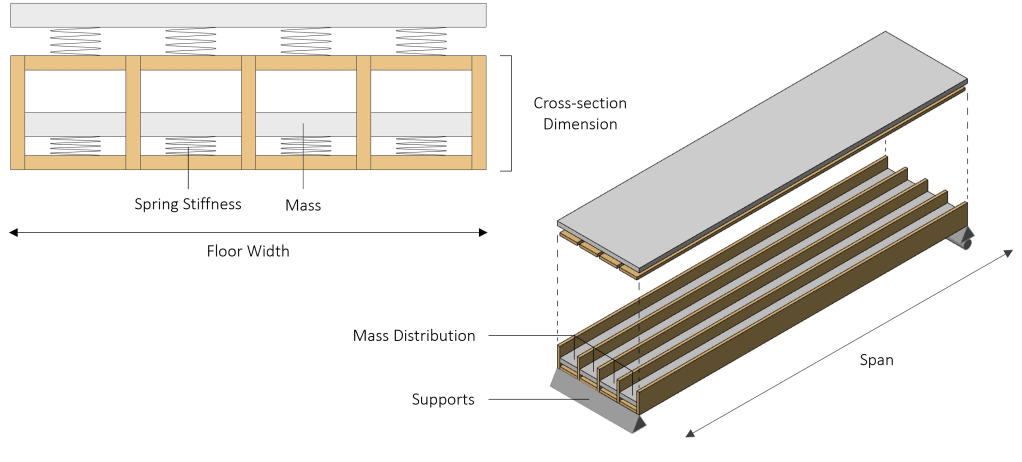
Based on this foundation, the following subsequent research question is formulated: “How can an optimal mass distribution inside a hollow timber floor system be established that minimizes material use and keeps human-induced vibrations within acceptable tolerance?”
Vibration Assessment
Effects of a vibration can be perceived through its direction, magnitude, frequency and duration. Furthermore, the perception also differs based on the orientation and activity of the observer (whether e.g. the person is lying down or standing up) (Hivoss, 2007). But how can this perception be quantified such that a human-induced vibration can be classified as ‘comfortable’? In current timber Eurocode guidelines, floors with an eigenfrequency higher than 8Hz need to be checked based on the velocity response of a unit impulse load and based on the ratio between the deflection due to a static force and the force itself. If the eigenfrequency of the floor is smaller than 8Hz, which can be the case for very large and lightweight floor spans, the Eurocode states that further research is required to assess its vibration performance (EN 1995-1-1).
One guideline, named “A Design Guide for Footfall Induced Vibration of Structures”, as published by the Concrete Centre, provides an extensive guide in assessing vibration sensitive structures for these cases smaller than 8Hz. In this guide it is stated that structures with a natural frequency less than 4.2 times the fastest possible walking frequency (so a frequency less than a value of around 10.5Hz) are to be designed for resonant response, whilst structures with a natural frequency higher than 10.5Hz should be designed for impulsive response (Willford & Young, 2006). Vibration performance of both response types are quantified based on their acceleration and velocity respectively.
Vibration Analysis Using Spring-Mass-Damper Systems
One of the analysis methods that can be used to obtain the vibration response of a timber floor, such as its displacement, velocity and acceleration, is a spring-mass-damper model (or from here on out called a SMD model). This model is based on the floor’s lumped mass, stiffness and damping properties in a certain vibration mode and determines its response under a specific loading, see figure.
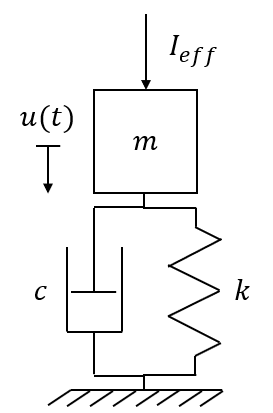
With this system, the eigenfrequency and free vibration of a basic Lignatur floor can be estimated. Properties such as the stiffness k, and mass m, are derived from standard equations related to the vibration of a simply supported beam at midspan. When this system is subjected to an effective design impulse Ieff, which induces the same peak structural response as the time history of a single footfall at the chosen location, the system experiences a cyclic displacement that is dampened out over time. The rate at which the vibration is dampened out depends on the viscous damping coefficient c, which is derived from a damping ratio ζ. This damping ratio is taken from literature (usually 1% and less than 5% for timber floors without the application of tuned mass dampers).
The displacement function u(t) of the mass in the SMD model is determined from solving the dynamic second order differential equation, see equation (1).
In order to solve this equation, an initial velocity v0 that is derived from the effective design impulse, is used. By differentiating the displacement function twice, the acceleration function of the beam a(t) can be derived. Using the derived mass, stiffness, and damping parameters from oen of the standard Lignatur floor systems, the acceleration response of a bare Lignatur floor (without mass-springs) at midspan can be seen in the figure below.
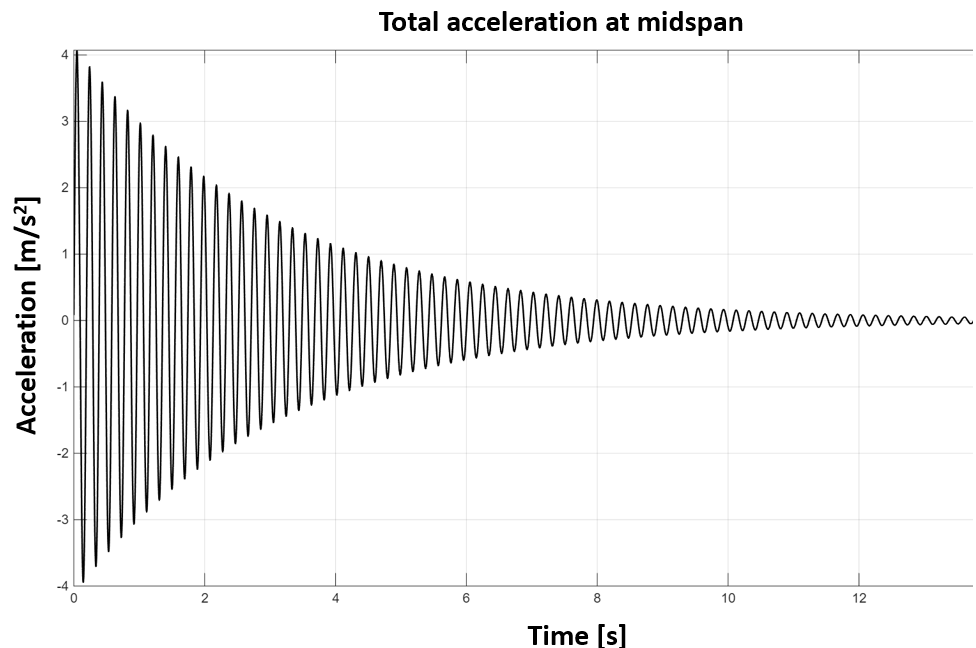
This floor example has a span of 10m, and its first mode is excited due to an effective design impulse of 23.71Ns. In this figure, it can be seen that the first natural frequency of the floor lies around 5Hz (5 vibration cycles per second), which showcases that already a bare Lignatur floor, requires further analysis and needs to be assessed on e.g. its resonant response.
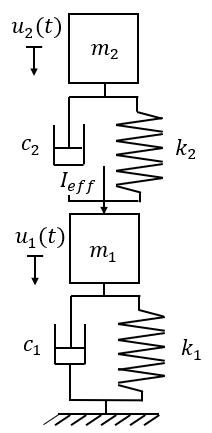
By adding another spring-mass-damper on top of the existing SMD model of the floor, the vibration response of the floor system including mass-spring-dampers can be determined. The mechanical model of the complete system can be seen in the figure below, and will be used in this research to determine the optimal amount of mass needed for vibration comfort.
References
(EN 1995-1-1: Eurocode 5: Design of Timber Structures – Part 1-1: General – Common Rules and Rules for Buildings, 2004)
Goor, T. P. T. Van De. (2024). Human-Induced Vibrations in Timber Floor Systems. (July).
Hivoss. (2007). Human induced Vibrations of Steel Structures Design of Footbridges. Hivoss, 55.
Willford, MR., & Young, P. M. (2006). A design guide for footfall induced vibration of structures. Concrete Society.
 RESED
RESED 