

Student: Jonas Chenderasa
Supervisor: Arjan Habraken (TU/e), Emanuela Bosco (TU/e), Roy Crielaard (Arup)
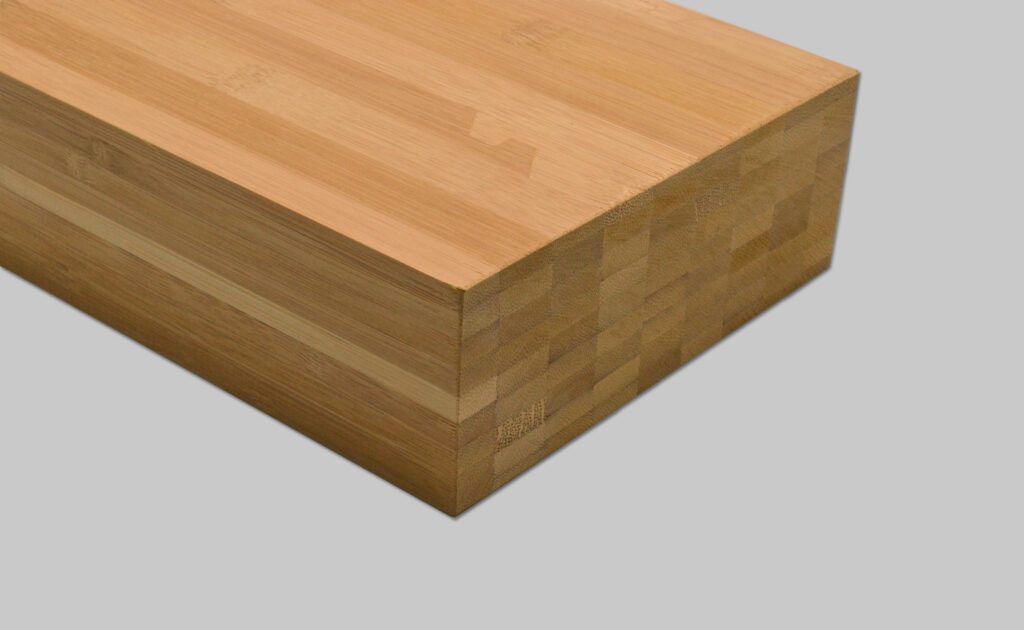
Engineered laminated bamboo is emerging as a promising bio‑based alternative to conventional structural materials. But before it can be used in European building practice, it must be aligned with Eurocode 5, the design standard for timber construction. Several open research tasks remain, my graduation project addresses one of them.
Why this matters
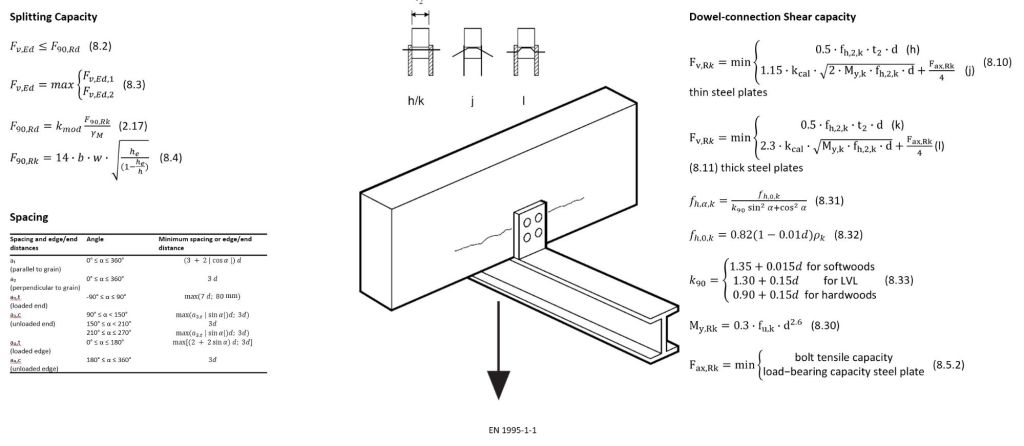
Like timber, laminated bamboo is the weakest perpendicular to the grain. This weakness governs how connections behave, especially when dowel‑type fasteners introduce forces that try to split the material. To design these connections, Eurocode 5 relies on a fracture parameter for the characteristic splitting capacity. For softwood, this is captured by a constant value of 14 in Equation 8.4 under Section 8.1.4.3. For bamboo, however, no such value exists yet.
Main Research Question
How can the connection capacity of Laminated Bamboo Lumber with dowel-type connections loaded perpendicular to the grain be established under the Eurocode 5 framework?
What my research investigates
To fill this gap, I study the fracture toughness of laminated bamboo, how easily its fibres separate when loaded perpendicular to the grain. This requires a fracture mechanics approach rather than a traditional strength/stiffness approach.
Approach:
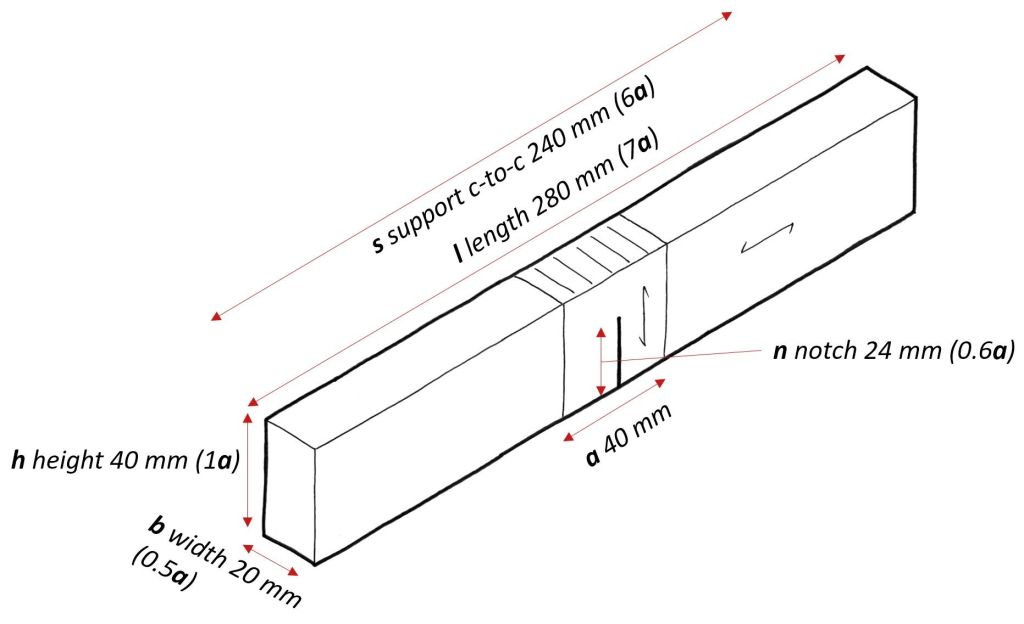
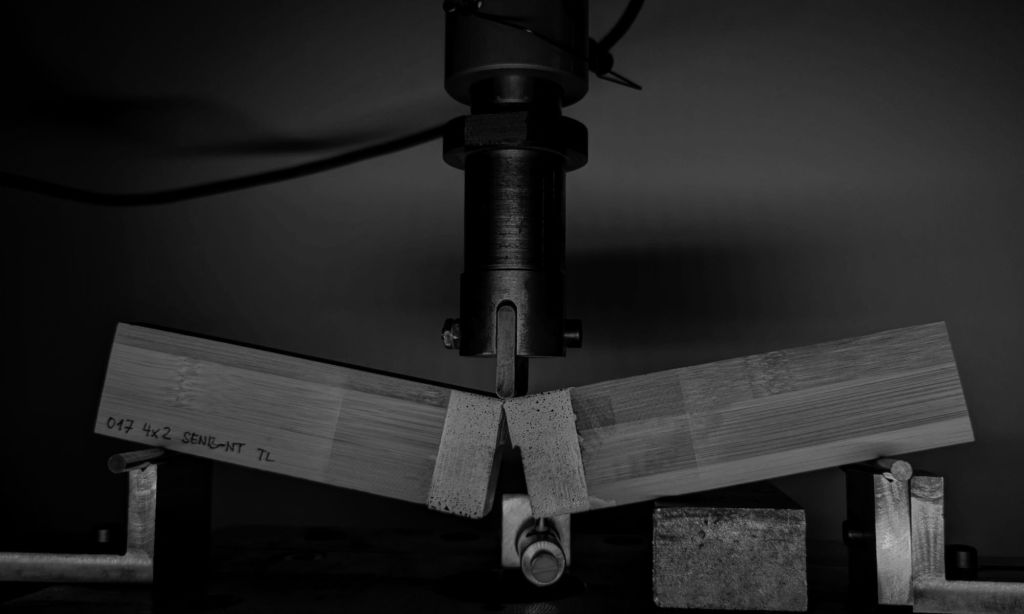
- Mode‑I (tension) fracture tests using Single‑Edge Notched Beam (SENB) specimens
- Mode‑II (in‑plane shear) fracture tests using End‑Notched Flexure (ENF) specimens
- Numerical validation through a Cohesive Zone Model in LS‑DYNA
Towards code-compliant bamboo structures
By combining experimental and numerical results as well as results from the literature, I aim to propose a bamboo‑specific fracture parameter analogous to the softwood value in Eurocode 5. This would enable engineers to calculate the splitting capacity of bamboo connections and design them reliably.
This work contributes to the broader effort outlined by Harries & Trujillo (2025) and others to integrate engineered bamboo into established design standards. Their goal is to develop an ISO Technical Report. Establishing the splitting capacity of laminated bamboo lumber is a key step toward making laminated bamboo lumber a viable, sustainable construction material.
Acknowledgment
This graduation project is supported by several partners and experts whose contributions are gratefully appreciated. Academic supervision is provided by Arjan Habraken (TU/e), Emanuela Bosco (TU/e), followed by company supervision from Roy Crielaard (Arup). The laminated bamboo specimens used in the experiments are supplied by Arjan van der Vegte of MOSO. Further research guidance was provided by David Trujillo from the University of Warwick, a prolific researcher in the field of structural use of bamboo.
Below you find more information:
Pros and Cons
Bamboo as a Pole
Benefits
- Bio-based building material
- Short harvest cycle (4–5 years)
- High carbon sequestration
- High strength
- High strength-to-weight ratio
- Naturally structurally efficient section and build-up
Challenges
- Lower modulus of elasticity
- Vulnerable to insects and decay if unprotected
- Irregular round geometry
- High volume-to-material shipping ratio
Engineered Laminated Bamboo
Benefits
- Standardized structural building material
- Flexible dimensions (e.g. sections depther then 24cm)
- Efficient volume-to-material shipping ratio
Challenges
- Bamboo is not covered by Eurocode 5
- Lack of established design values
- Requiring project-based approval
- Making projects expensive or unfeasible
Approch
Mode‑I Fracture Testing (SENB)
The mode‑I fracture tests follow the principles of the 1993 Nordtest method for determining fracture energy in tension perpendicular to the grain. In this approach, a Single‑Edge Notched Beam specimen is loaded in bending so that the pre‑crack opens in pure tension. The complete force-displacement response is recorded, and the fracture energy is obtained from the mechanical work required to propagate the crack, normalized by the fractured area.
Mode‑II Fracture Testing (ENF)
End‑Notched Flexure specimens are loaded to induce in-plane shear along a notch. The measured mechanical work required for crack growth provides the mode‑II fracture toughness. Mode-I and Mode-II are combined for a mixed-mode result.
Numerical Validation (Cohesive Zone Model)
The fracture behaviour measured in the laboratory is verified through a numerical model based on the Cohesive Zone Method in LS‑DYNA. This approach can show actual crack formation rather than only reduced stiffness. The specimen geometry is generated and meshed using a Grasshopper script. Keywords (LS‑DYNA model language) are placed inside of LS-PrePost, and the model is validated with Oasys Primer. Because cracks can only form where cohesive elements are placed, the meshing is critical for accurately capturing the fracture behavior. Cohesive interface elements are inserted along the predefined crack path. These elements follow a traction-separation diagram.
References
Harries, K. A., & Trujillo, D. (2025). Opportunities and limitations for the design of engineered bamboo structures using design standards for wood. Journal of Building Engineering, 114, 114125. https://doi.org/10.1016/j.jobe.2025.114125
Jonasson, J. et al. (2024). Fracture energy of birch in tension perpendicular to grain: experimental evaluation and comparative numerical simulations. Wood Science and Technology (2024) 58:1925–1949 https://doi.org/10.1007/s00226-024-01595-6
Chen, Y. et al. (2023). A Review of Experimental Research on the Mode I Fracture Behavior of Bamboo. Journal of Renewable Materials 2023, 11(6), 2787-2808. https://doi.org/10.32604/jrm.2023.027634
van der Put, TACM., & Leijten, AJM. (2000). Evaluation of perpendicular to grain failure of beams caused by concentrated loads of joints, V31 september 2000. Delft University of Technology. https://research.tudelft.nl/en/publications/evaluation-of-perpendicular-to-grain-failure-of-beams-caused-by-c-2/
 RESED
RESED 