Integrating Semi-Rigid Joint Stiffness into Complex Timber Gridshell Modelling for Improved Accuracy
Student: Kaj Hasenaar
Supervisors : Arjan Habraken, Joey Janssen
The construction industry has a significant impact on the environment, primarily due to the large quantities of materials used in load-bearing structures. As construction activity continues to grow, there is increasing pressure to design structures that use less material and produce fewer CO₂ emissions. Timber is a promising material in this transition because it is renewable, stores carbon, and has a much lower environmental impact than steel or concrete. However, designing reliable timber structures remains challenging due to the material’s directional properties and long-term behaviour.
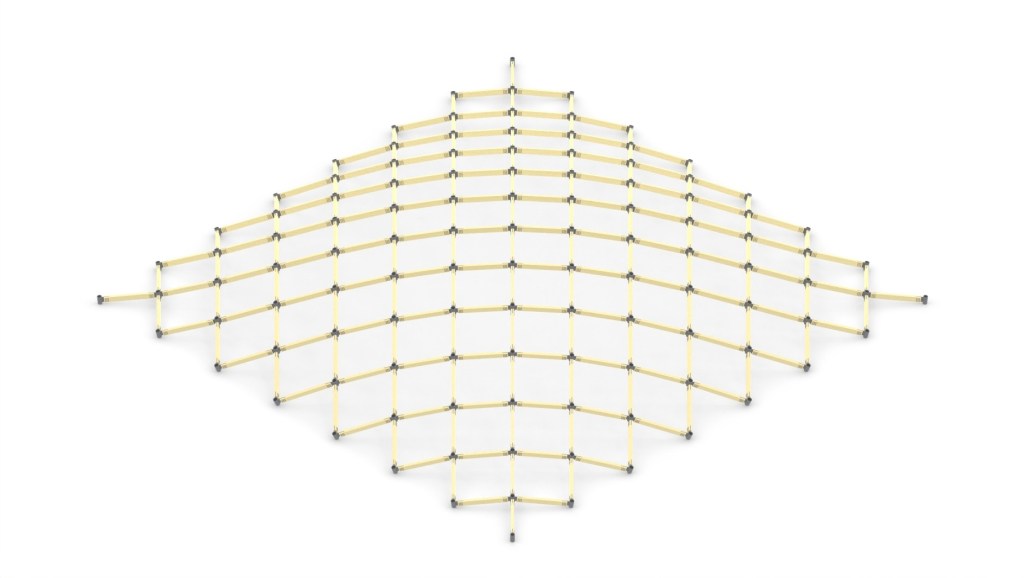
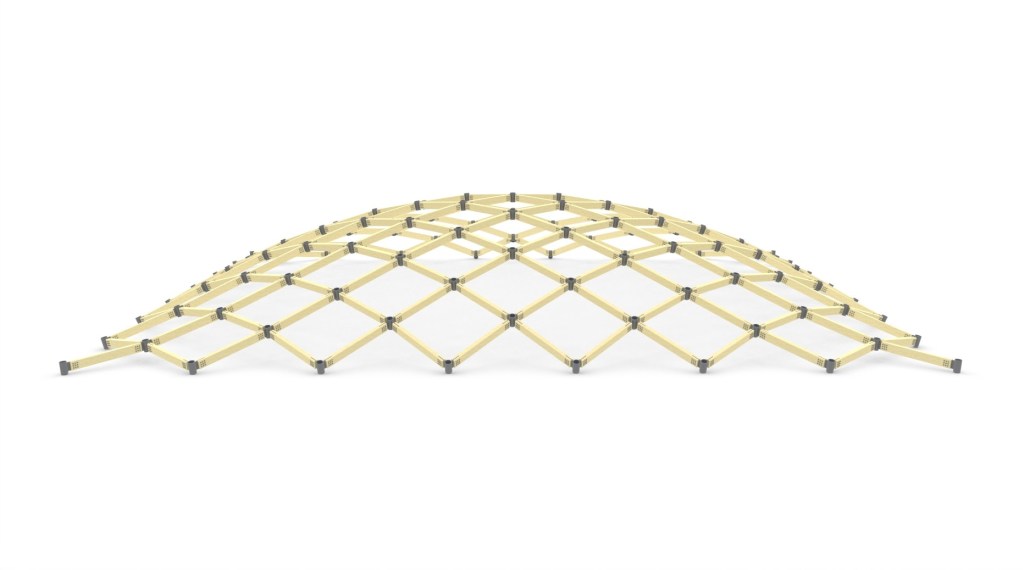
Timber gridshells are lightweight structures that can span large distances using slender elements, making them both material-efficient and architecturally expressive. Their behaviour, however, is strongly influenced by how the elements are connected and their geometry. In current digital design and structural analysis, these connections are often simplified, even though timber joints commonly behave in a semi-rigid way. This simplification can lead to inaccurate predictions of stiffness, deformation, and overall structural performance.
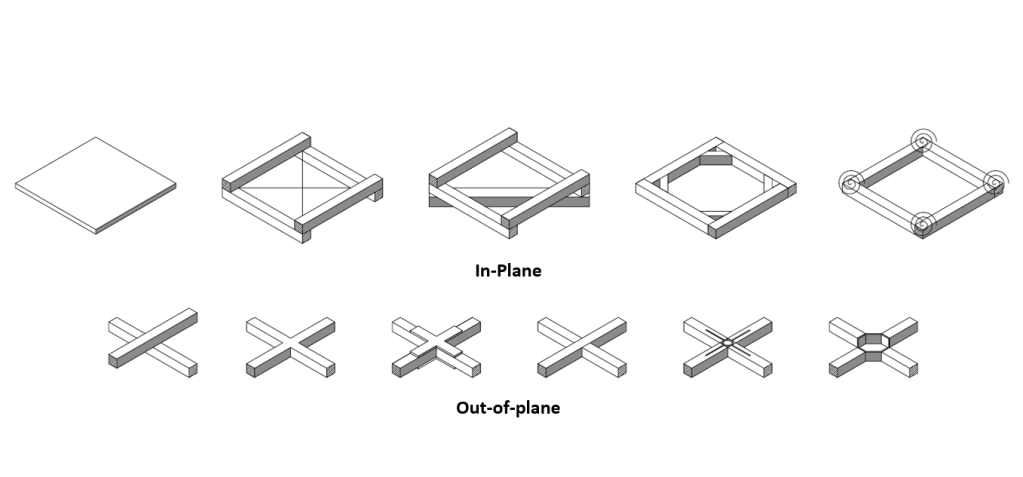
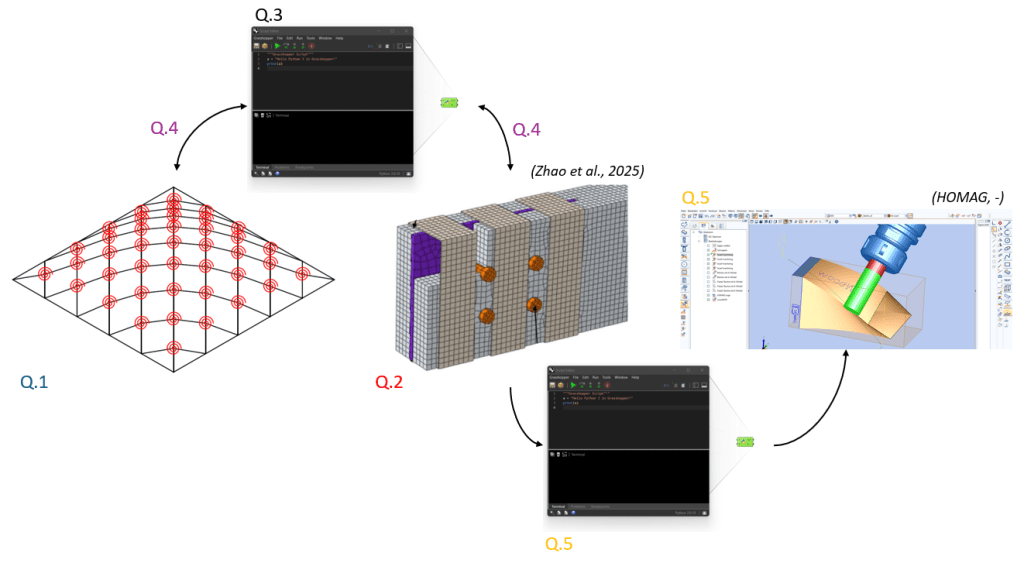
This research investigates how the stiffness of semi-rigid timber joints affects the behaviour and design of unbraced quadrilateral timber gridshells. By developing a parametric digital workflow that links Grasshopper, RFEM, and Abaqus, the study connects joint-level behaviour with the global response of the structure. The research focuses on gridshells whose shapes are driven by architectural and fabrication constraints rather than purely structural optimisation, and it examines both short-term and long-term deformations.
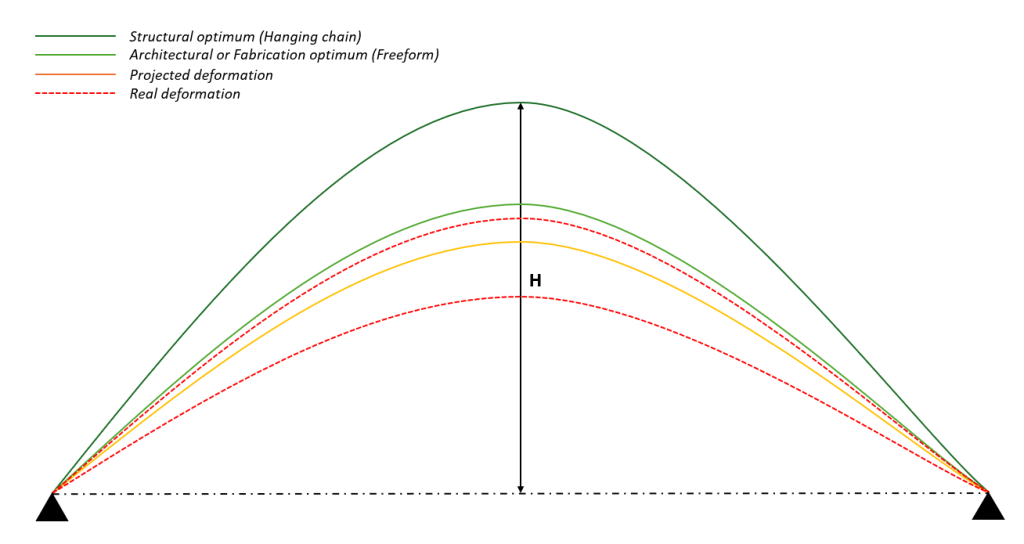
By improving how joint stiffness is represented in structural models and linking this directly to fabrication logic, the project aims to make timber gridshell design more reliable, predictable, and feasible. Ultimately, this contributes to the wider goal of enabling efficient and sustainable timber structures that can be realistically built.
To achieve this goal, the following research and sub-questions are to be answered:
How do material and geometric parameters impact the stiffness of semi-rigid timber joints, and how does this relationship influence the designed form, structural performance, and fabrication strategies of unbraced quadrilateral timber gridshells?
- How do variable node stiffnesses affect the behaviour of unbraced quadrilateral gridshells?
- What are the stiffnesses and behaviours of common timber connections found using the simulation of the joints modelled in Grasshopper?
- How can Python code create an efficient workflow between RFEM 6, Abaqus, and Grasshopper?
- How do the stiffnesses and behaviours of common timber connections affect the behaviour of unbraced quadrilateral gridshells?
- How can the nodes designed in Grasshopper be applied in computer-aided fabrication?
References
Adriaenssens, Sigrid., Block, Philippe., Veenendaal, Diederik. and Williams, Chris. (2014) Shell structures for architecture : form finding and optimization. Routledge/ Taylor & Francis Group.
Block, Philippe., Mele, T. van., Rippmann, Matthias. and Paulson, N.C.. (2017) “Beyond bending : reimagining compression shells,” p. 190.
Dyvik, S.H., Haakonsen, S.M., Luczkowski, M. and Komiyama, Y. (2023) “Aluminium nodes for timber gridshells: Parametric detailing of node principles,” International Journal of Space Structures. SAGE Publications Inc., pp. 217–232. Available at: https://doi.org/10.1177/09560599231180155.
Dyvik, S.H., Manum, B. and Rønnquist, A. (2021) “Gridshells in recent research—a systematic mapping study,” Applied Sciences (Switzerland), 11(24). Available at: https://doi.org/10.3390/app112411731.
Hill, C.A.S. and Dibdiakova, J. (2016) “The environmental impact of wood compared to other building materials,” International Wood Products Journal, 7(4), pp. 215–219. Available at: https://doi.org/10.1080/20426445.2016.1190166.
Holzer, S.M., Loferski, J.R. and Dillard, D.A. (1988) A REVIEW OF CREEP IN WOOD: CONCEPTS RELEVANT TO DEVELOP LONG-TERM BEHAVIOR PREDICTIONS FOR WOOD STRUCTURES.
Isufi F. (2021) Parametric design of a grid shell roof over existing buildings, with a focus on connection design.
Kumar, V., Lo Ricco, M., Bergman, R.D., Nepal, P. and Poudyal, N.C. (2024) “Environmental impact assessment of mass timber, structural steel, and reinforced concrete buildings based on the 2021 international building code provisions,” Building and Environment, 251. Available at: https://doi.org/10.1016/j.buildenv.2024.111195.
Larsson, S. (2018) Design Implications of Rigid Timber Gridshells: A Method for the Planning and Manufacture of Load-carrying, Rigid, Freeform Structures of Timber. Sweden.
Li, R., Chen, A., Yang, L., He, G. and Wang, H. (2025) “Experimental study on long-term performance of simply-supported Glulam beams connected with steel joining plates and bolts,” Structures, 73. Available at: https://doi.org/10.1016/j.istruc.2025.108439.
NEN (2014) NEN-EN 1995-1-1:2005+A2:2014+NB:2013 Hout – Algemeen, BRISwarenhuis. Available at: https://www.briswarenhuis.nl/docs/norm/nen-en1995-1-1-2005%5B3%5D (Accessed: October 16, 2025).
NEN (2019) NEN-EN 1990:2002+A1:2019+NB:2019 Grondslagen van het constructief ontwerp. NEN.
OECD (2019) Global Material Resources Outlook to 2060: Economic Drivers and Environmental Consequences. Paris: OECD Publishing. Available at: https://doi.org/10.1787/9789264307452-en.
Spengler van F. (2024) Parametric design of grid shell structures: A design method considering semi-rigid joints and stiffness based connection design.
Sporchia, F., Bruno, M., Neri, E., Pulselli, F.M., Patrizi, N. and Bastianoni, S. (2025) “Complementing emergy evaluation and life cycle assessment for enlightening the environmental benefits of using engineered timber in the building sector,” Science of the Total Environment, 970. Available at: https://doi.org/10.1016/j.scitotenv.2025.179030.
UNEP (2023) Building materials and the climate: constructing a new future. United Nations Environment Programme. Available at: https://wedocs.unep.org/20.500.11822/43293 (Accessed: October 14, 2025).
Williams, C. (2017) Decisions to be made in the design and analysis of gridshell structures. France: École Nationale des Ponts et Chaussées. Available at: https://www.youtube.com/watch?v=VPSw3dRE6xQ (Accessed: October 14, 2025).
Yuan, P.F., Jin, J., Han, L. and Chai, H. (2019) “Structural design of gridshells aiming at lightweight design and rapid assembly,” IASS Symposium 2019 – 60th Anniversary Symposium of the International Association for Shell and Spatial Structures; Structural Membranes 2019 – 9th International Conference on Textile Composites and Inflatable Structures, FORM and FORCE, pp. 1539–1546.
 RESED
RESED 