

Student : Luuk Kassing
Supervisors : Arjan Habraken, Faas Moonen
“Mobile and reusable structures have become more prevalent including the use of retractable roofs. Most retractable roof types consist of large rigid elements which are retracted by translation or rotation, but such a transformation requires undesired large ground areas.
To minimize these large areas, a radially retractable roof structure can be developed.
This deployable structure is characterized as a pantographic structure in which scissor-like elements enable geometrical foldability. Like the mechanics of a scissor, the structure is folded around a joint causing a change in configuration as illustrated by (Akgün et al., 2011). Using the same principle, the radially retractable roof structure can fold radially outwards from the closed to open configuration.
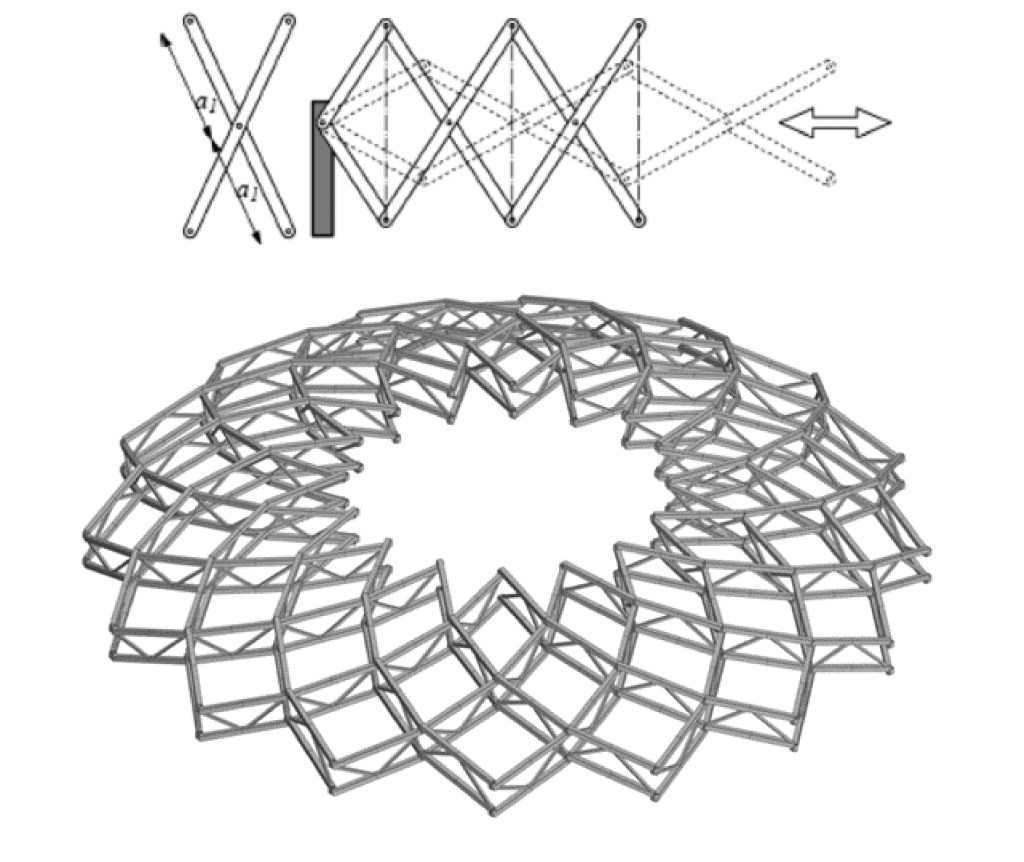
To investigate and evaluate the structural behavior of the radially retractable roof, a parametric model is developed with the help of the Grasshopper. As a starting point, a circular radially retractable roof structure of 50 meters diameter will be analyzed. The structure consists of a double layer diagrid structural system connected by diagonal elements, forming truss structures. The diagrid structural system is created by a specific number of multi-angulated elements (MAE’s) in the clockwise and counterclockwise direction. These MAE’s are continuous structural elements with multiple kinks, forming an arch by multiple straight segments. The model incorporates multiple parameters (e.g. number of MAE’s, number of diagonals in trusses, total structural height, truss height, etc.) to provide the opportunity to investigate the structural behavior comprehensively.”
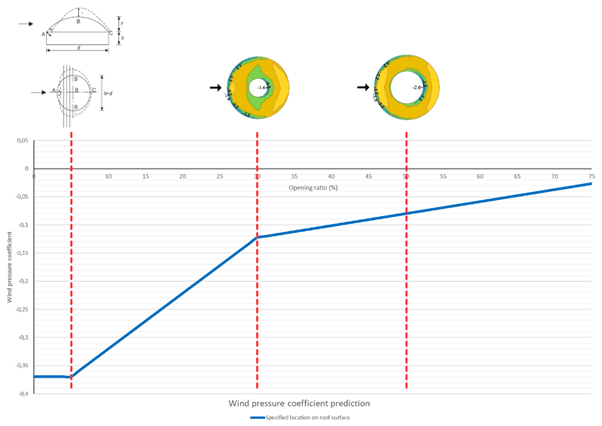
“The radially retractable roof will be exposed to changing wind loads. Due to the possibility of changing configurations by the retractable roof, it is difficult to predict the wind loads in all configurations. The Eurocode gives guidelines for relatively common situations. However, the retractable roof cannot be represented by only one of these cases. Furthermore, stadium roofs with circular central openings are not included in the Eurocodes. For that reason, wind load predictions are made based on three situations: a combination of the closed dome situation from the Eurocode between 0% and 5% opening ratios, and research findings of Cheon et al. (2021) in external wind pressure coefficients for a 30% as well as 50% opening ratios. The result is visualized in the graph for one specified location on the roof surface. For configurations in-between these prescribed situations, interpolation is used. Beyond the 50% configuration, the configuration is predicted by further extrapolation of the curve.”
 RESED
RESED 