

Student : Tomas M. Hermsen
Supervisors : Arjan Habraken, Faas Moonen, Gert-Jan Rozemeijer
26-10-2023
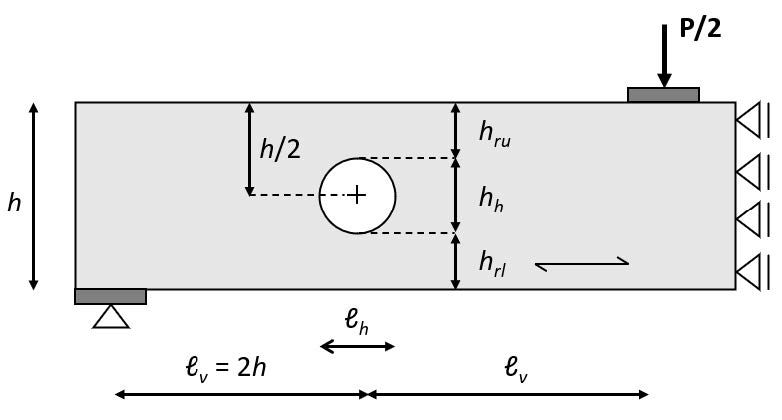
Introducing holes in glulam beams disrupts the stress flow, causing redistribution of shear and bending stresses around the hole. This redistribution leads to tensile stresses perp. to the grain and increased shear stresses in the vicinity of a hole. The failure mechanism is well manifested and involves crack propagation along the grain of unreinforced and reinforced holes at the location where the tensile stresses reach their maximum. Experimental tests showed cracks consistently initiated near the mid-width of the cross-section due to the cylindrical anisotropy of wood. This study investigated the cylindrical anisotropy of wood on the structural behaviour of holes in glulam beams. A comparative analysis between the orthotropic and cylindrical anisotropic models demonstrates an inhomogeneous stress distribution with pronounced stress peaks for the cylindrical anisotropic model. The study investigated the influence of three reinforcement scenarios: 1 rod, 2 rods and plywood panels. Rods placed at an angle of 45° achieve the most significant reductions for these pronounced stress peaks, particularly in the scenario with a single rod.
Keywords: Glulam, Holes, Cylindrical anisotropy of wood, Reinforcements, FEM, Tensile stresses perp. to the grain
Cite this
Holes in glued laminated timber beams: The influence of the cylindrical anisotropy of wood on the stress distribution of unreinforced and reinforced holes
Hermsen, T. M. (Author). 26 Oct 2023
 RESED
RESED 