

Student: Elise Wielinga
Supervisors: Arjan Habraken, Akke Suiker, Gert-Jan Rozemeijer
24-08-2023
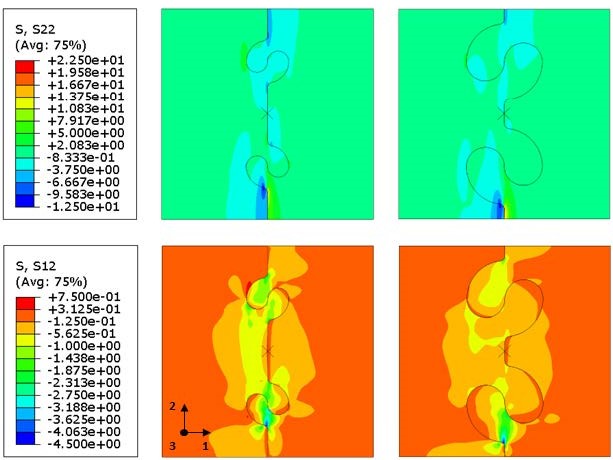
In this thesis, Linear Elastic Finite Element Analyses are performed to analyse the influence of the shape of interlocking timber connections on their strength capacity. Dovetail, arrow and yin yang shaped connections with varying geometric parameters are investigated. Their height, width, radii and fillet radii are varied. Parametric scripts are created for automated creation of the Finite Element Models and for post-processing the results. The strength optimization study was performed using two failure criteria, where the peak or average stresses are compared to the design strength of the 18 mm thick spruce plywood. The connections will be applied in plywood diaphragm floor seams, therefore two critical load conditions are determined including tension and shear. The interlocking timber connection with the largest tension strength capacity made from 18 mm thick spruce plywood is a dovetail with ℎ1 of 180 mm, 𝑤1 of 80 mm, 𝑤2 of 20 mm and 𝑓𝑟1 of 15 mm. The interlocking timber connection with the largest shear strength capacity is a dovetail with ℎ1 of 190 mm, 𝑤1 80 of mm, 𝑤2 of 20 mm and 𝑓𝑟1 of 15 mm. The most important factor was the area for contact pressure. The dovetail was able to accommodate the largest space to transfer the stresses from one component to the other. Tension stress parallel was critical for most tension load case designs whereas tension stress perpendicular was critical for all shear load case designs. An example of application of interlocking timber connections in conventional structures is given on the first floor of the WikiHouse.
Keywords: Timber structures, WikiHouse, Finite Element Analyses, Timber connections, Plywood,
Cite this
Finite Element Analysis of Interlocking Timber Connections in Plywood Diaphragm Floors: Optimizing Form for Strength
Wielinga, E. (Author). 29 Aug 2023
 RESED
RESED 