

Student: Teun van Warmerdam
Supervisors: Arjan Habraken, Faas Moonen, Thijs Lambrechts
30-05-2024
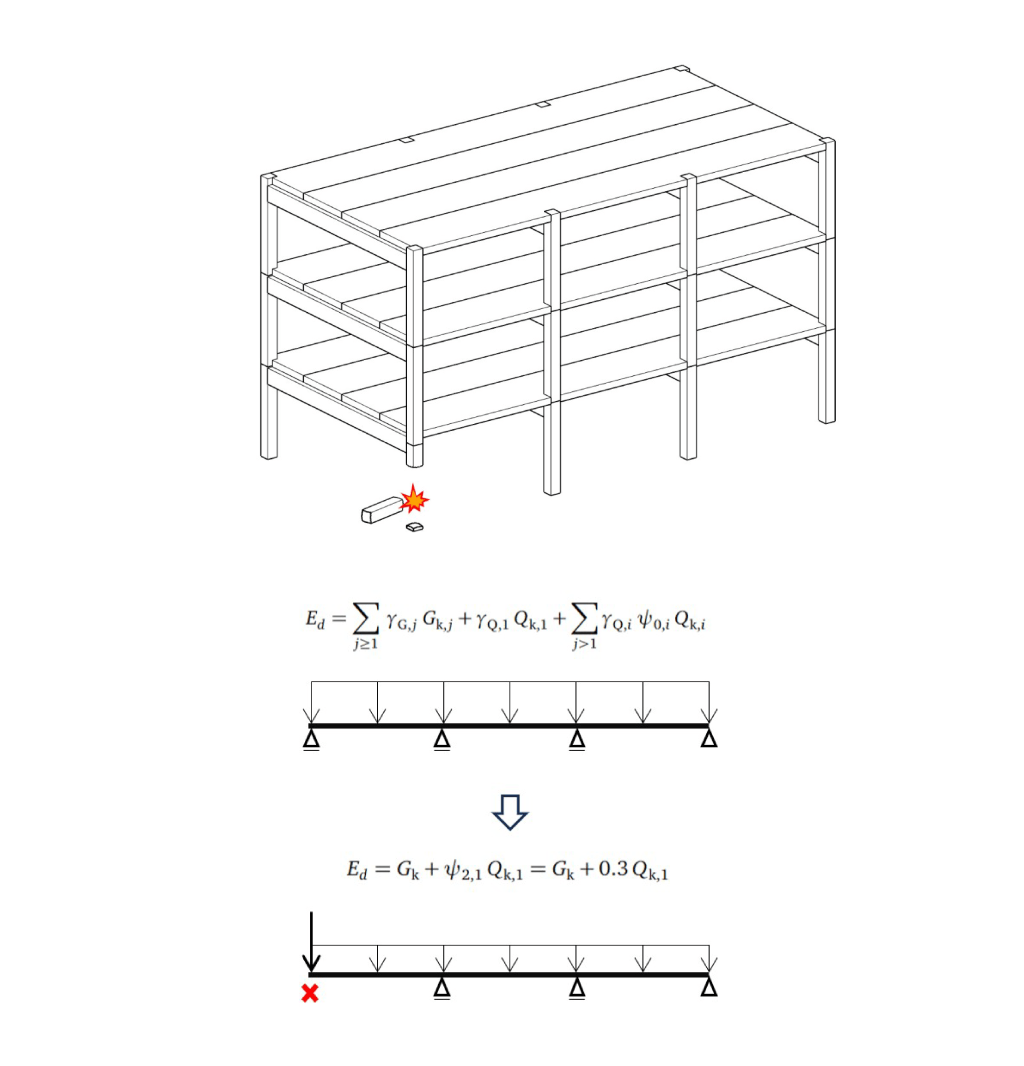
With the emergence of engineered timber as a structural material and, as a result, timber structures increasing in size and height, the robustness of timber buildings becomes of interest. Existing Eurocode recommendations and literature on robustness are written mostly with steel and reinforced concrete structures in mind. Moreover, Eurocode recommendations on robust structures can lead to unsafe design due to a lack of guidance on dynamic amplification in accidental load cases and shortcomings in the tension tie recommendations. This thesis explores the technical feasibility of continuous and staggered timber floor elements to provide a secondary load path in accidental column loss scenarios for timber column and beam structures. The typology of the analyzed timber structure is a six-story CC2b office structure, analyzed for spans ranging from 3 to 9 meters. Two timber floor element types are assessed: CLT plate elements and Lignatur box floor elements. First, the required cross-sectional height of the floor elements is determined for the standard design situation (SLS and ULS). Then, the required cross-sectional height in the accidental design state is determined by assessing the demanded capacities in notional corner, edge, and middle column removal scenarios. In the column removal scenarios, a Dynamic Load Factor of 2.0 accounts for the amplification of loads at sudden column loss. The comparison between required cross-sectional heights in standard design situations and accidental scenarios indicates the technical feasibility and possible additional material costs of a secondary load path throughtimber floorelements. Other elements in the analyzed structure, such as beams, columns, and connections, are checked for required dimensions and capacity in the standard design situation and column loss scenarios as well to see if they need strengthening. The structural analysis, derivation of load distributions, dimensioning of elements, and analysis of elements are all performed by manual calculation methods and validated using several SCIA Engineer models.
The results show that robustness by secondary load paths through timber floor elements is possible for timber column and beam structures. The corner column loss scenario is the most demanding column loss scenario, being most often normative for the cross-sectional height of the floor elements and restricting the floor span to a certain maximum. The CLT f loorelementscanproviderobustnessforlongerspansthantheLignaturfloorelementsand at less significant element height increase. The secondary load path through CLT elements does not require additional material for spans between 7.0 and 8.5 meters for the continuous floor element layout. The staggered floor layout performs significantly worse than the continuous layout, with smaller spans possible and a need for a larger cross-sectional height increase. Several column and connection locations along the edge of the building parallel to the floor span require additional strengthening or design for tensile loads in accidental scenarios.
Keywords: Timber structures, Robust design, Eurocode, CLT, Columns, Floors, Accidental loads
Cite this
Feasibility study of an alternative load path through floor elements for timber column and beam structures in accidental column removal scenarios
van Warmerdam, T. (Auteur). 30 mei 2024
 RESED
RESED 