

Student: Luc M.J. Roex
Supervisors: Arjan Habraken, Faas Moonen, Arjen Deetman
25-01-2025
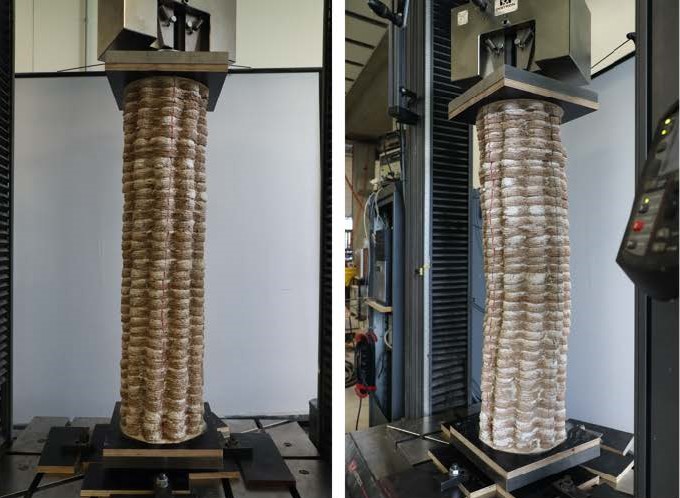
The work presented investigates the application of a 3D printed bio-based material for construction purposes. A new printable bio-based material is being developed for the Direct Ink Writing (DIW) method, whose material properties are then determined through mechanical testing. The focus is on 3D printing wood with the main components cellulose and lignin. With the new printable mixture, a structural element (column) was printed to load in axial compression. The column was numerically optimized to maximize buckling resistance. The optimized design was fabricated by additive manufacturing. Additive manufacturing offers opportunities for the built environment to create innovative structural elements in a fully digitised manufacturing process. Moreover, the combination of numerical optimization, innovative structural design and robotic printing with bio-based materials enables the design and production of structures with a high degree of freedom. This leads to less environmental pollution caused by traditional design and manufacturing processes in the construction industry. The printed column of bio-based material was tested in axial compression after curing, resulting in a maximum compressive strength of 46.82 kN. Although the structural behaviour of the biobased printed column was promising, further research needs to be conducted to conclude whether the printed material is suitable for large-scale construction purposes.
Keywords: Additive manufacturing, DIW method, bio-based material, mechanical testing, innovative structural design, optimization, axial compression, parametric design
Cite this
Structural performance of a three dimensional bio-based parametric structural element, through additive manufacturing
Roex, L. M. J. (Author). 25 Jan 2024
 RESED
RESED 