

Student : Edwin van Houte
Supervisors :
Arjan Habraken (TU/e), Faas Moonen (TU/e), Susanne Bron – van der Jagt (Level Acoustics and Vibrations)
Contents
- Contents
- Introduction
- Preliminary connector design
- Floor analysis
- Structural performance
- Vibration performance
- Acoustic performance
- Conclusion & Recommendations
Introduction
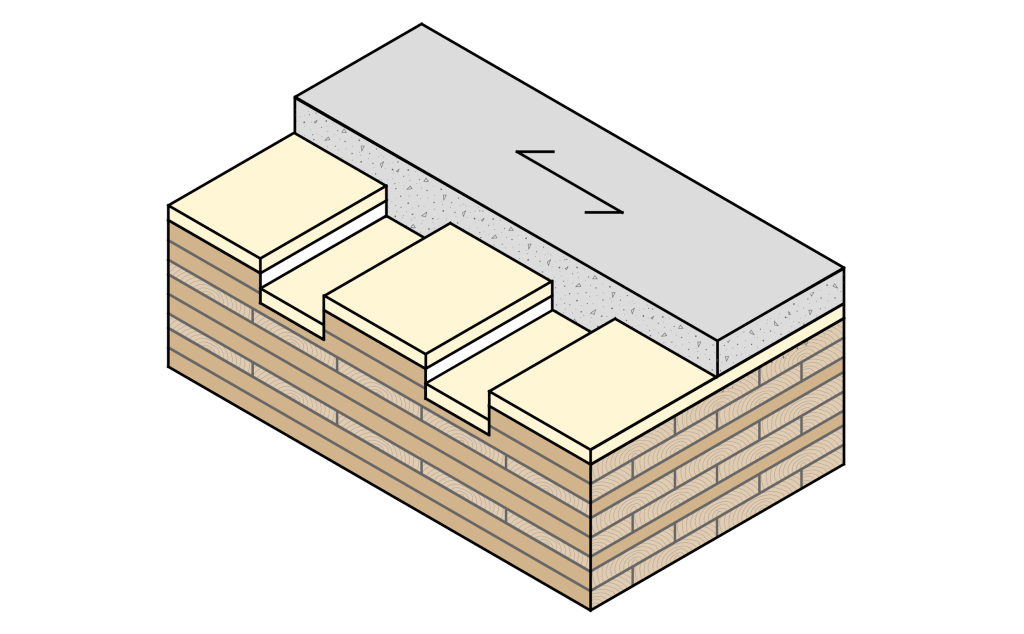
This master’s thesis explores an innovative approach to enhance the vibro-acoustical performance of CLT–Concrete Composite (CCC) floors by integrating a resilient layer between the CLT and concrete, while maintaining the structural composite interaction.
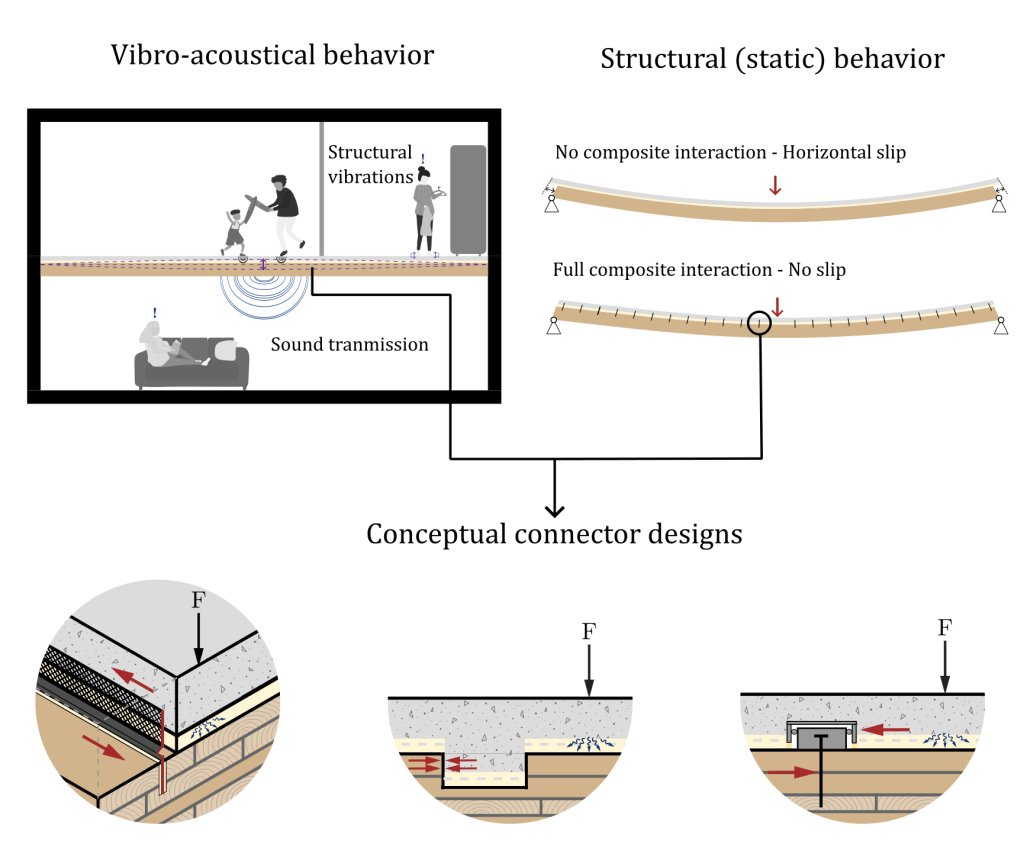
While CCC floors have caught the eye of researchers and the industry due to its structural efficiency, slenderness, transverse stiffness and favorable vibro-acoustical properties compared to timber floors and reduced environmental impact and low weight relative to concrete floors, it cross-section often still needs to be increased, or a floating floor added, to reach the desirable criteria for tactile structural vibrations and sound transmission. This leads to significant increased structural (e.g. significant increased dimensions) and even less preferred non-structural material usage (heavy floating screed or suspended ceilings), which also results in increased weight and total floorheight. This lowers its pratical applicability in the context where it shows significant potential: longspan flexible multistory buildings. The goal of the research therefore is to explore if there is potential in using the conceptual design with an integrated resilient layer between the structural CLT and Concrete layers, which provide increased damping and acoustic decoupling and thus lowers the need for additional measures for its dynamic performance. Additional focus will be put on the design of the connection detail which prevents horizontal slip between the structural layers and therefore maintaining the structural composite interaction.
Preliminary connector design
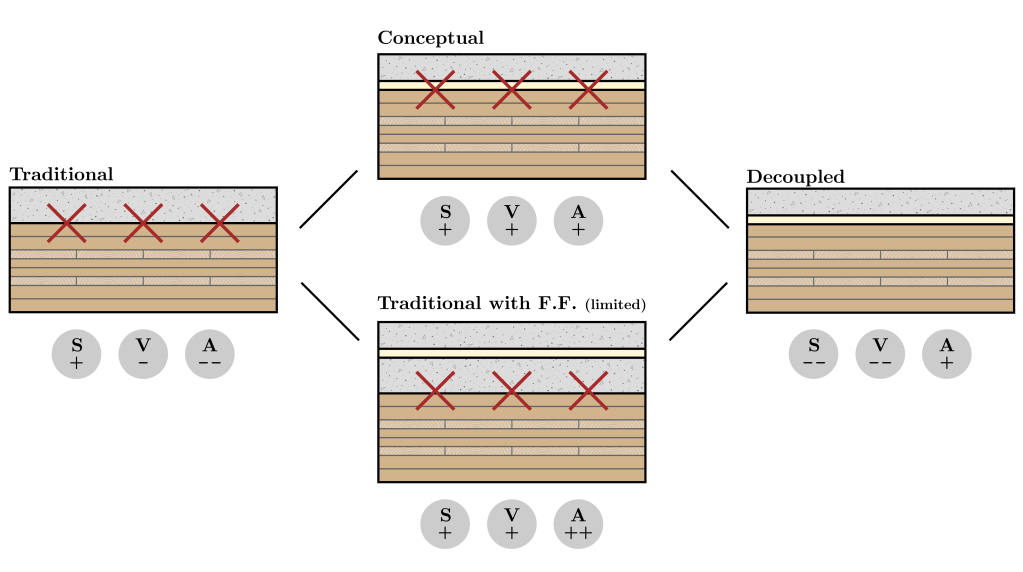
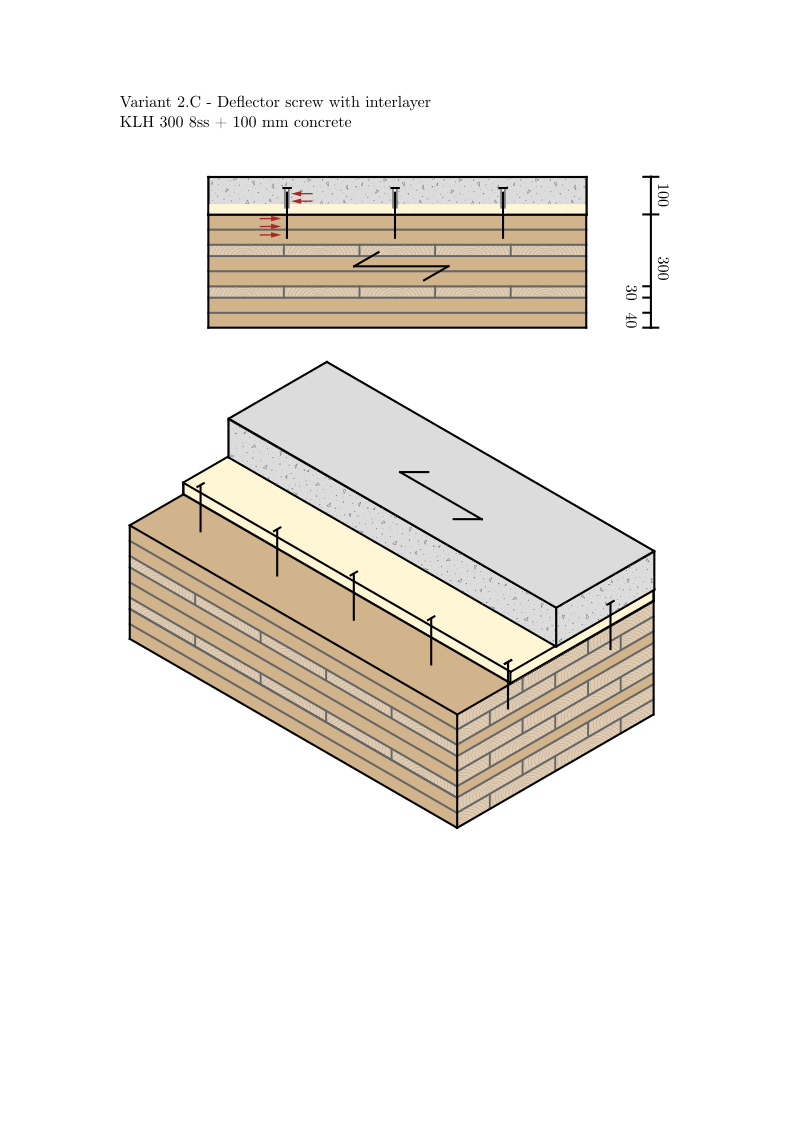
The first part of the research featured the design of the critical connection detail. Firstly a variant study was completed where different types of the connection details were assesed and compared to each other using literature background and qualitative argumentation. From the variant study four main variant types where determined:
Steel mesh connectors
- Standard mesh offers high stiffness and ductile failure but poor acoustic performance and complex installation.
- Adding insulation improves damping and acoustic behavior only slightly (due to the stiffness continues mesh through the insulation layer), but reduces stiffness.
- Further modifications introduce compliant profiles (Z-, V-, dovetail shapes) for better decoupling, though they raise concerns about structural integrity and manufacturing complexity.
- Overall mesh connectors either showed too little potential for decoupling or had low expected structural integraty and buildability.
Screw connectors
- Perpendicular screws are simple but provide low stiffness and poor vibration performance.
- Inclined screws significantly improve stiffness but significantly lose effectiveness when insulation is added.
- Conceptual “deflector screws” allow vertical movement for acoustic benefits but require further development for strength and buildability.
- Overall, screw-based solutions featured too little stiffness to create significant composite interaction.
Notch connections
- Continuous rectangular notches deliver high stiffness but lack damping and decoupling.
- Adding insulation and PTFE strips is expected to greatly improve acoustic and vibration performance with minimal stiffness loss.
- Versions with fasteners enhance structural integrity but reduce decoupling.
- Discrete and triangular notches offer better dynamic performance but increase manufacturing complexity.
Innovative connectors
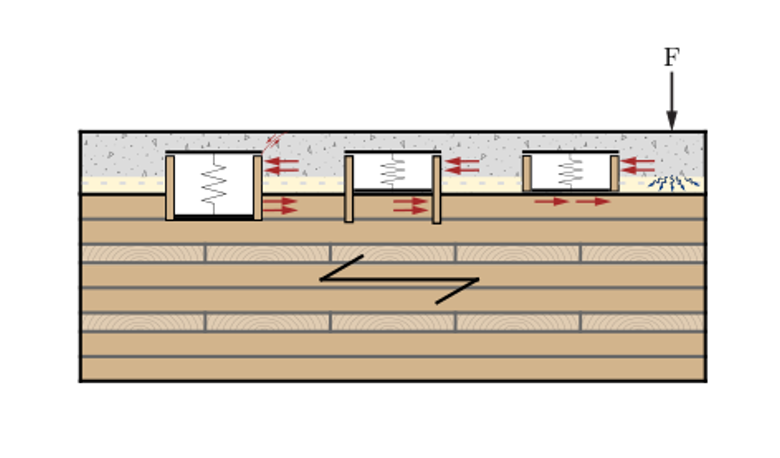
- Innovative ideas include spring boxes, compliant plates, and rollers.
- These aim for maximum decoupling but suffer from low expected stiffness, high complexity, and uncertain durability.
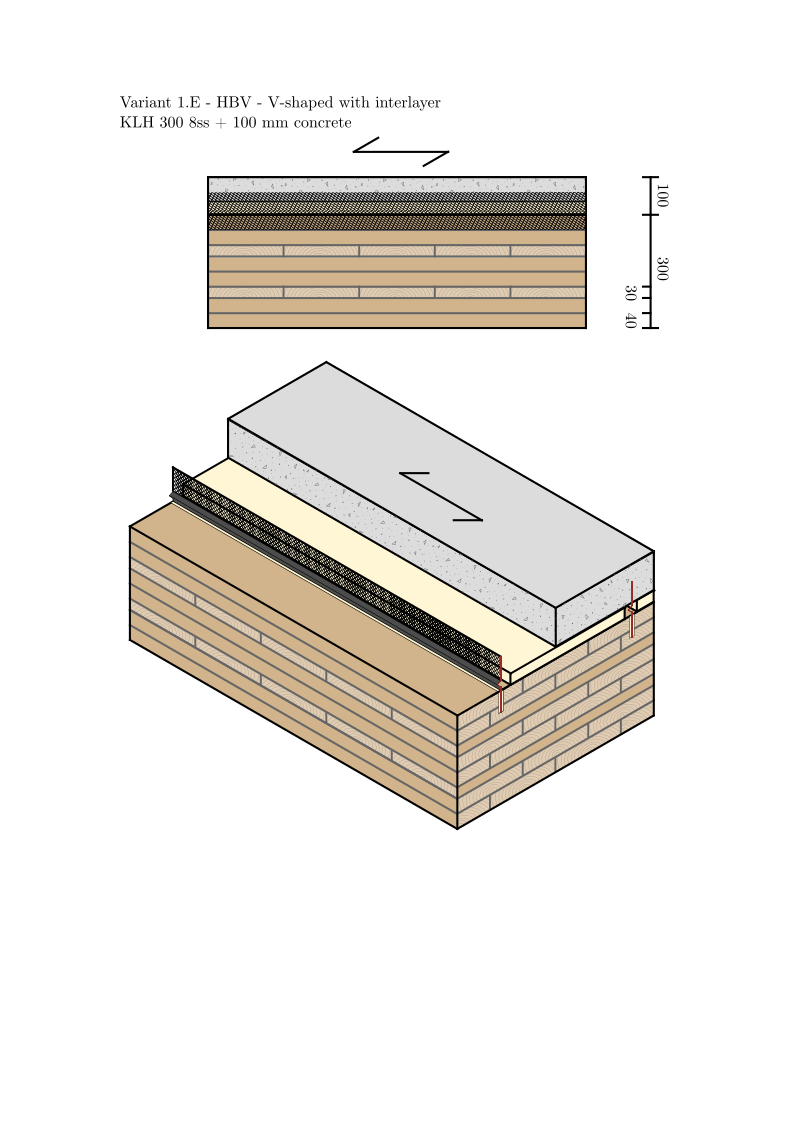
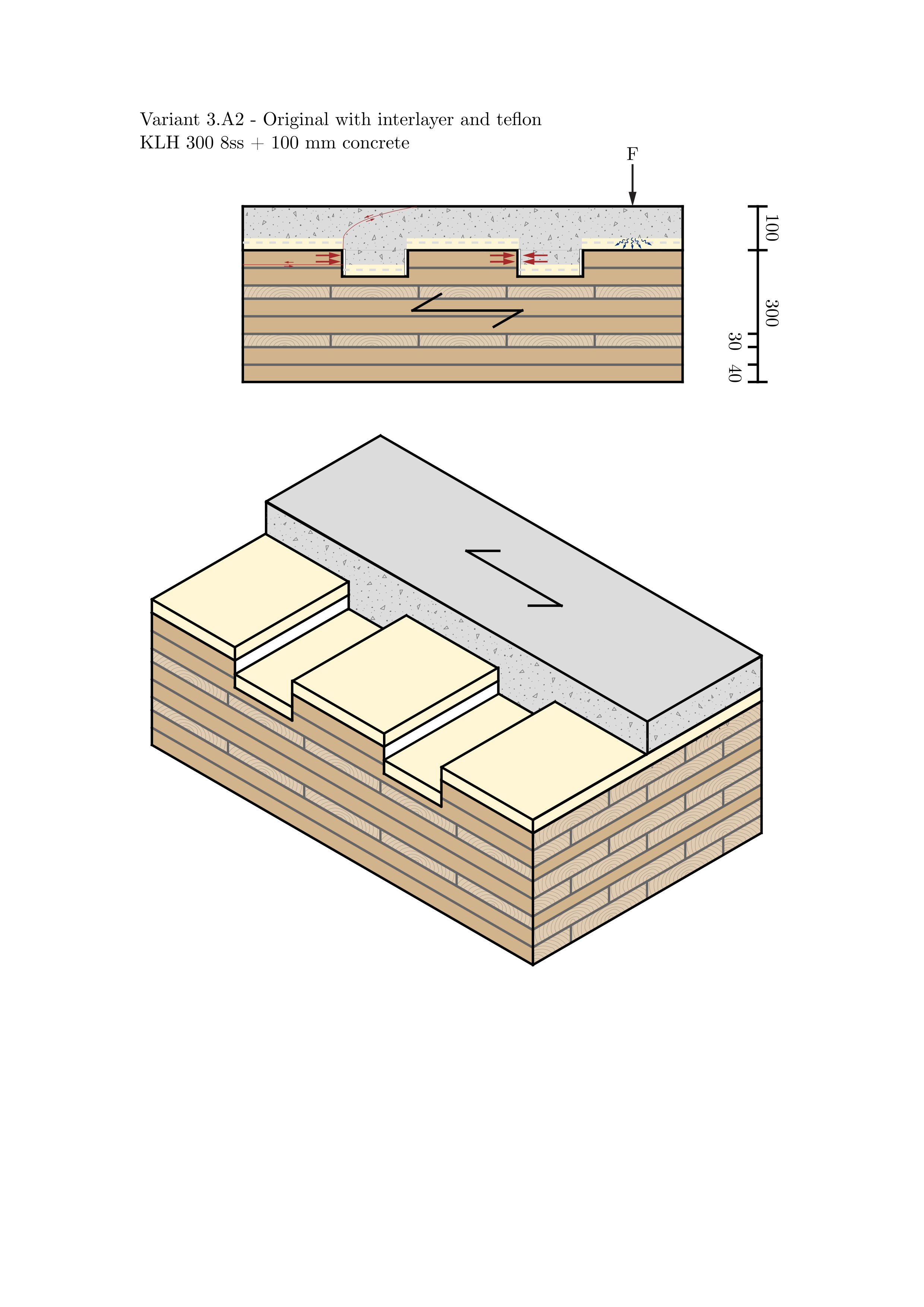
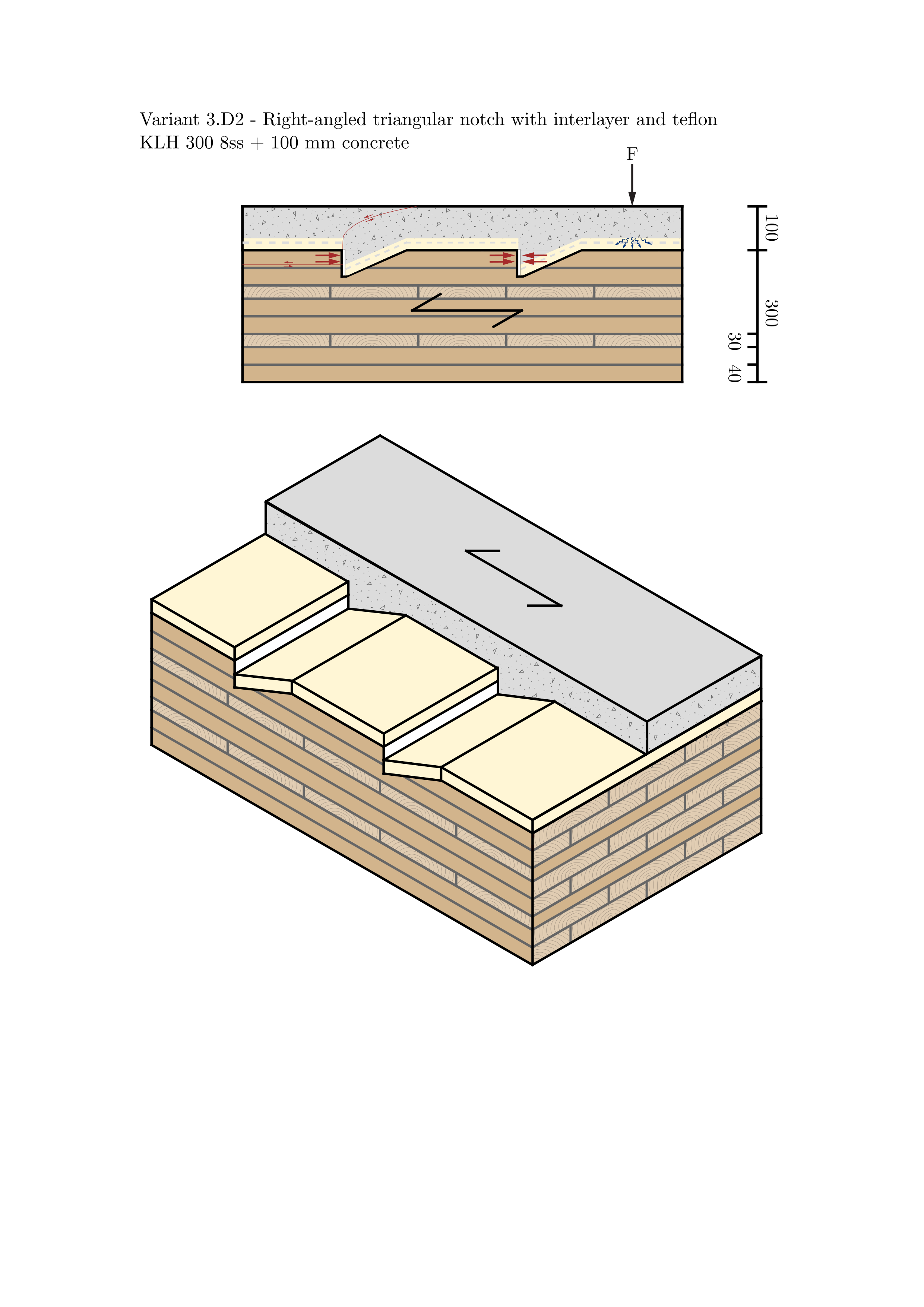
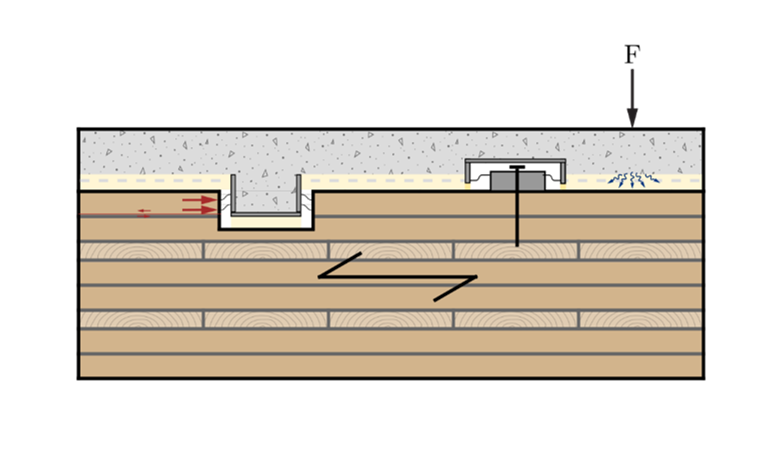
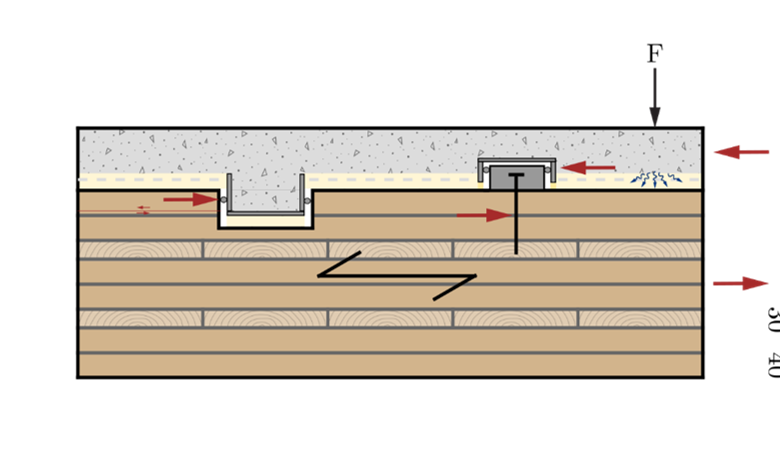
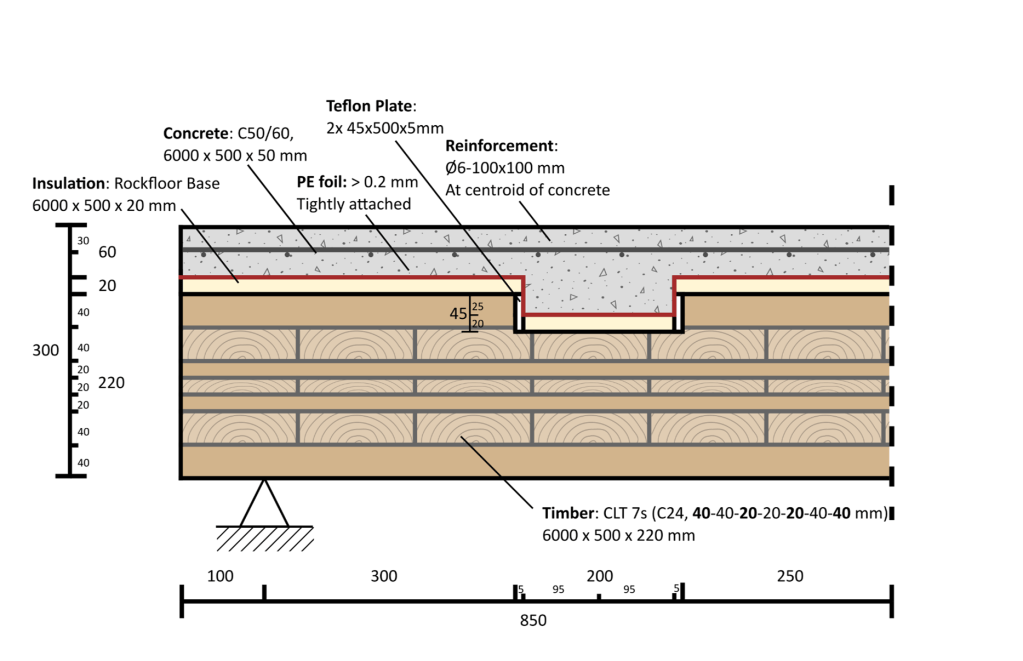
PTFE strips are applied to notch sides to minimize friction during shear transfer, allowing vertical movement and thus allow acoustic decoupling. A moisture-retaining foil prevents water ingress and unwanted bonding between timber and concrete, ensuring shear transfer occurs through the notch. Combined with PTFE, the foil further reduces friction. A horizontal steel reinforcement mesh is added to prevent shrinkage cracks and improve bending resistance under partly floating conditions.
Two alternatives were explored to address structural challenges from the absence of notch fasteners. Fasteners typically provide vertical reinforcement, improve ductility, and prevent timber-concrete separation. A “decoupled fastener” concept was proposed, allowing vertical movement while maintaining integrity, but was dismissed due to practical limitations. Adding stirrups to improve concrete shear resistance was also considered but excluded for comparability.
Floor analysis
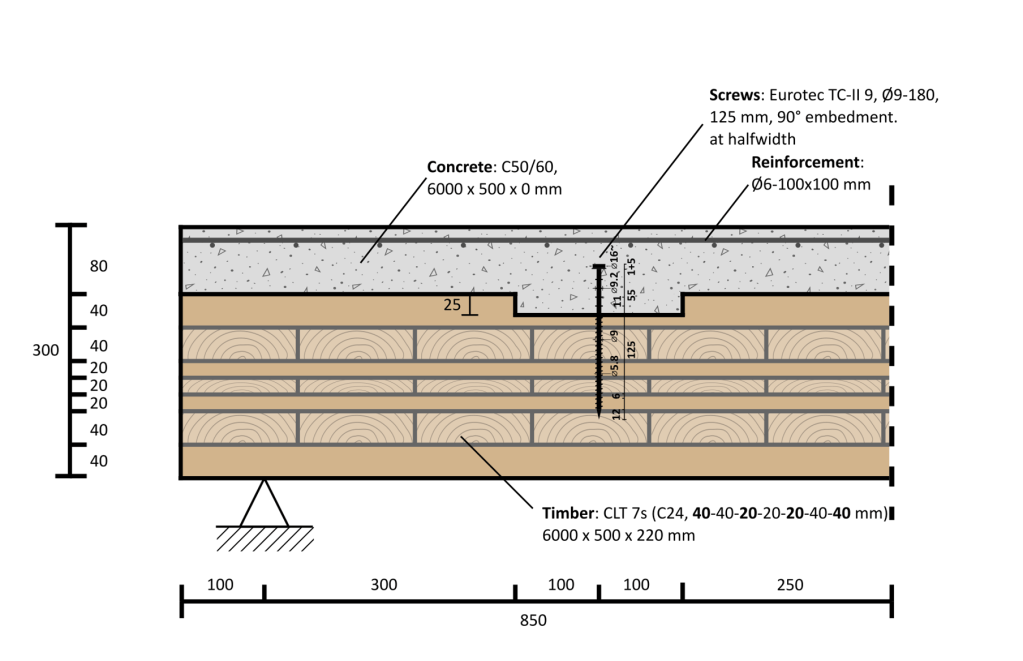
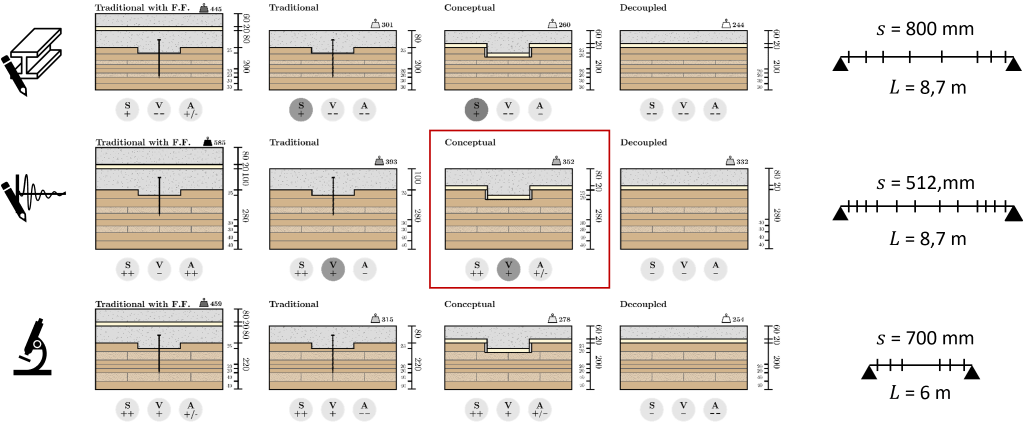
In the second part of the research, full span reference floors were analysed on static structural, vibration and acoustic performance. Three sets of reference floors were created. The Large Span Designs (LSD) feature floors with an 8.7m span with the traditional CCC floors and conceptual CCC floors designed to be at the limit of required structural performance. The corresponding decoupled floors is simply the conceptual floor design without connectors and the corresponding traditional floor with F.F. is simply the traditional floor with an additional floating floor of 20 mm insulation and 70 mm screed. The set of LSD+ designs feature a properties but where designed also taking into account the vibration performance. Lastly, the set of ED designs were based on the for experimental testing available 6 m long traditional CCC floor.
Structural performance
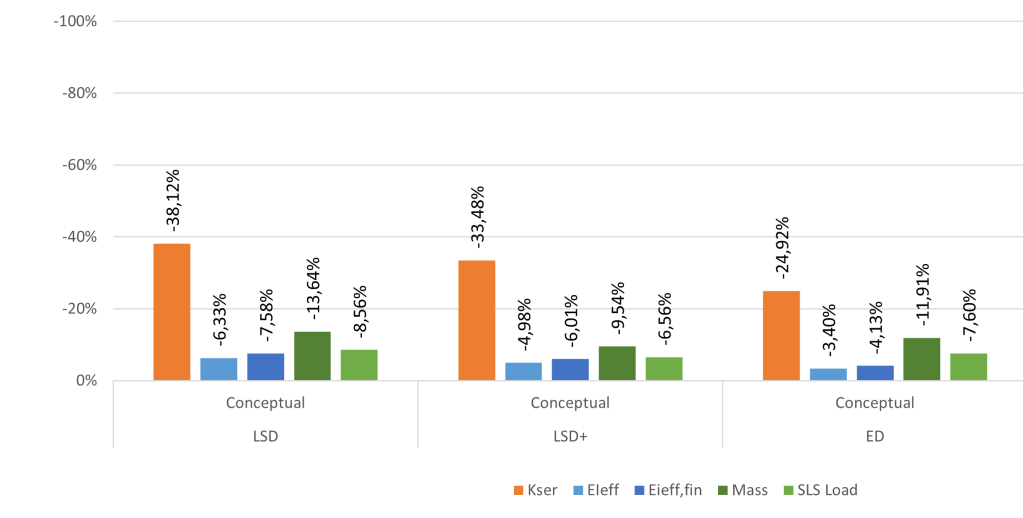
The structural performance was first analytically assessed mainly using the extended gamma method. To acquire the connection stiffness for the conceptual design a push-out test was recreated in FEM software. While this showed an significant decrease in stiffness ranging from -25% to -40%, when applied in the full floor analysis only a stiffness drop of approximately -10% was observed. Since the conceptual floor is also lighter the decrease in performance became minimal. The failures mechanisms were partly calculated using methods described in the eurocode and it’s extension about TCC floors. However, since these only gave options for calculation of failure mechanisms for a notched connection with a screw for vertical reinforcement the method described by Boccadoro et al. in 2016 about unreinforced notch connections was additionally used.
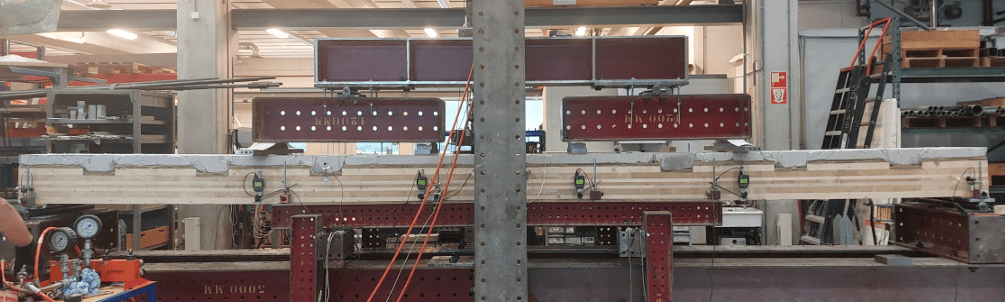
Besides the analytical analysis, an experimental 6 point bending test was conducted for the ED traditional and Conceptual floor. The figures below show the results for the traditional floor, featuring a mainly linear behavior with a minimal 3% lower stiffness compared to the analytical determined stiffness. Before testing the speciment feature very small hairline cracks around the notch edges due to shrinkage. In this area, the first cracks also show up. However, structural integrity was never fully lost within the force range of the test.
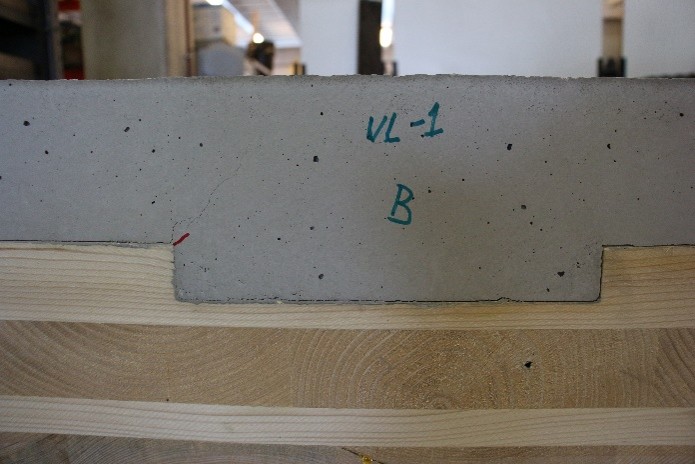
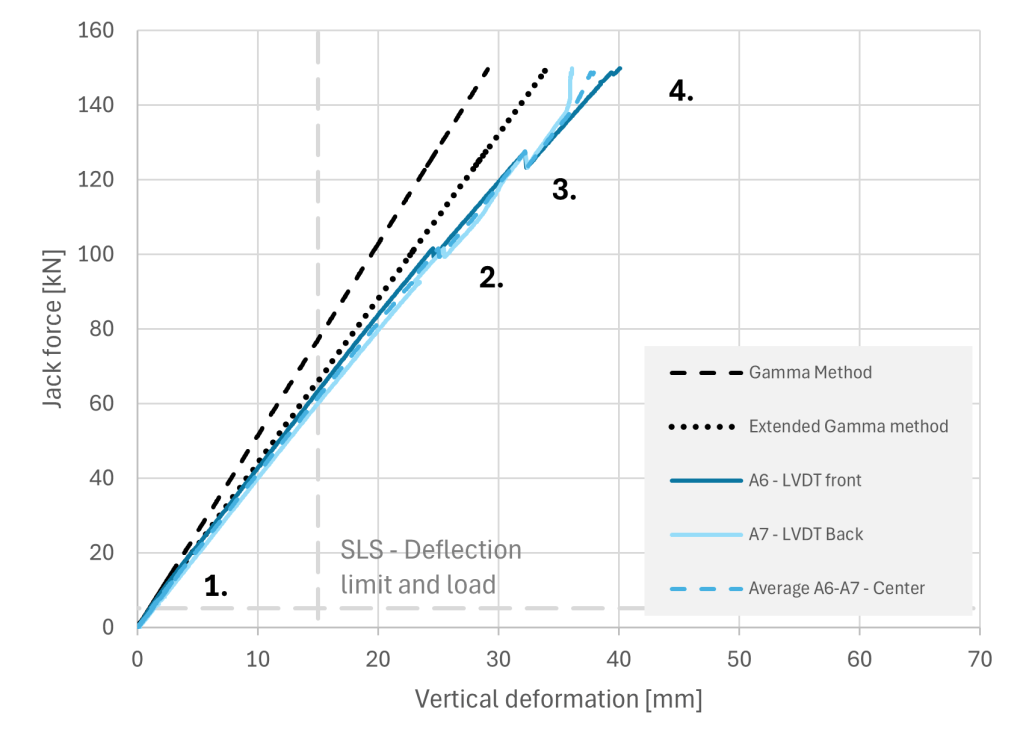
The figures below show the test results for the conceptual floor. Similarly, it showed linear behavior but now with a 13% lower stiffness then analytically determined. Besides, the experimental stiffness compared to the traditional floor was 14% lower. This higher decrease then found in the analytical comparison could possibly be explained by increased specimen imperfections. In contrast to the traditional floor, at 140 kN not only a hairline crack occured but it progressed and created a significant crack. Afterwards was only a little bit capacity left due to redistributions and the three notches on the other side simultaneously failed. The third one also in concrete shear failure and the 1st and 2nd one in timber shearing-off failure.
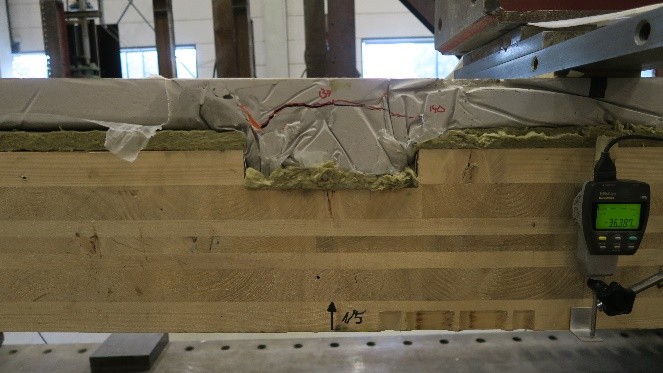
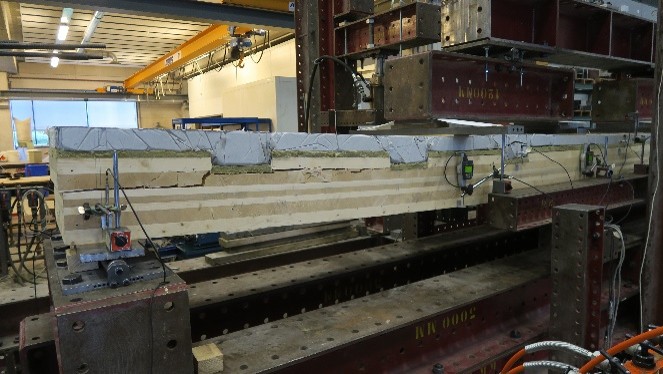
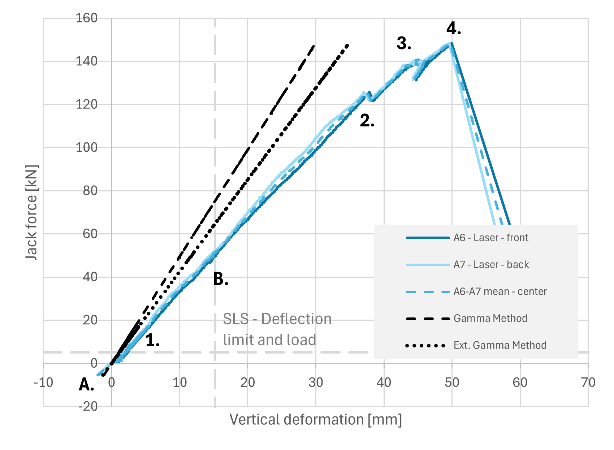
Overall, the conceptual floors only showed limited decrease in structural performance compared to the traditional floors. Eventhough the numerically determined connection stiffness significantly decreased, the conceptual floor only featured a 3-14% decrease. Furthermore, it was noted that the analytically determined failure mechanisms did not allign with the experimental testing, confirmed the need for further investigation of notch connections without a fastener connecting the concrete and timber. However, even though the predictability is uncertain and the conceptual specimen did fail while the traditional specimen did not, the failure load was much larger then the required capacity for ULS loading and SLS conditions are often governing. It can therefore be concluded that the conceptual floors feature a similar structural performance compared to traditional floors.
Vibration performance
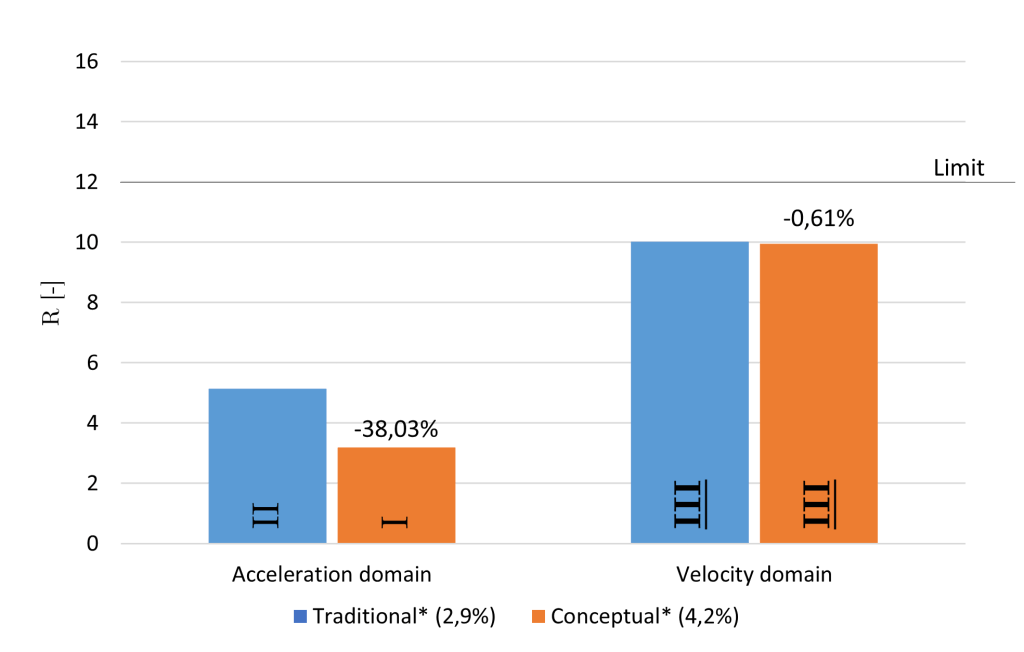
The vibration performance was analytically, numerically and experimentally investigated. Since the impactful damping coefficient of the conceptual floor was unknown, the conceptual floors were investigated with a 2,5% damping similar to the traditional floors as lower boundary and 3,5% damping similar to traditional floors with a floating covering floor as upper boundary. The analytical approach used the properties derived from the analytical approach for the structural performance and inserting them into the new method mentioned in the upcoming revised eurocode 5 (ReEC5). Next to a static deformation check it allows to calculate a derive the response factor through the resonance domain (using the response acceleration) and the transient domain (using the responce velocity) based on the natural frequency of the system.
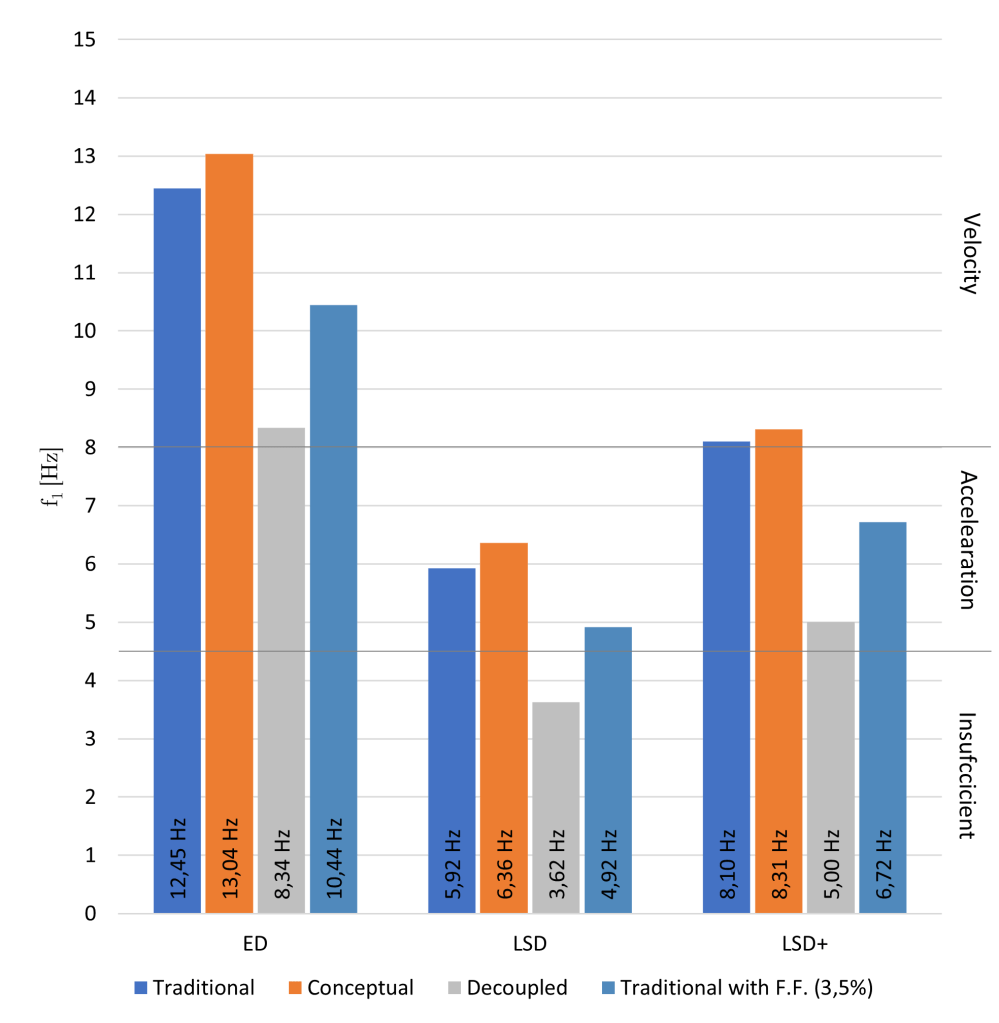
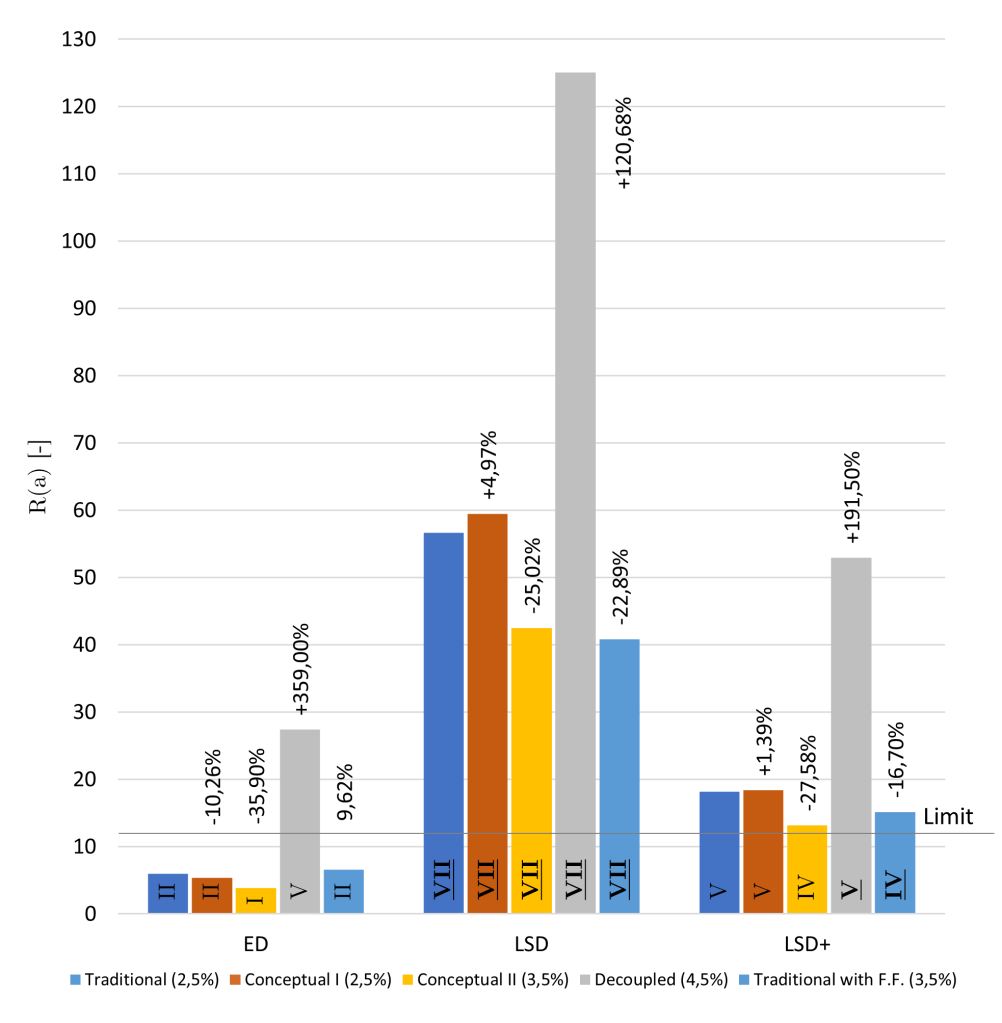
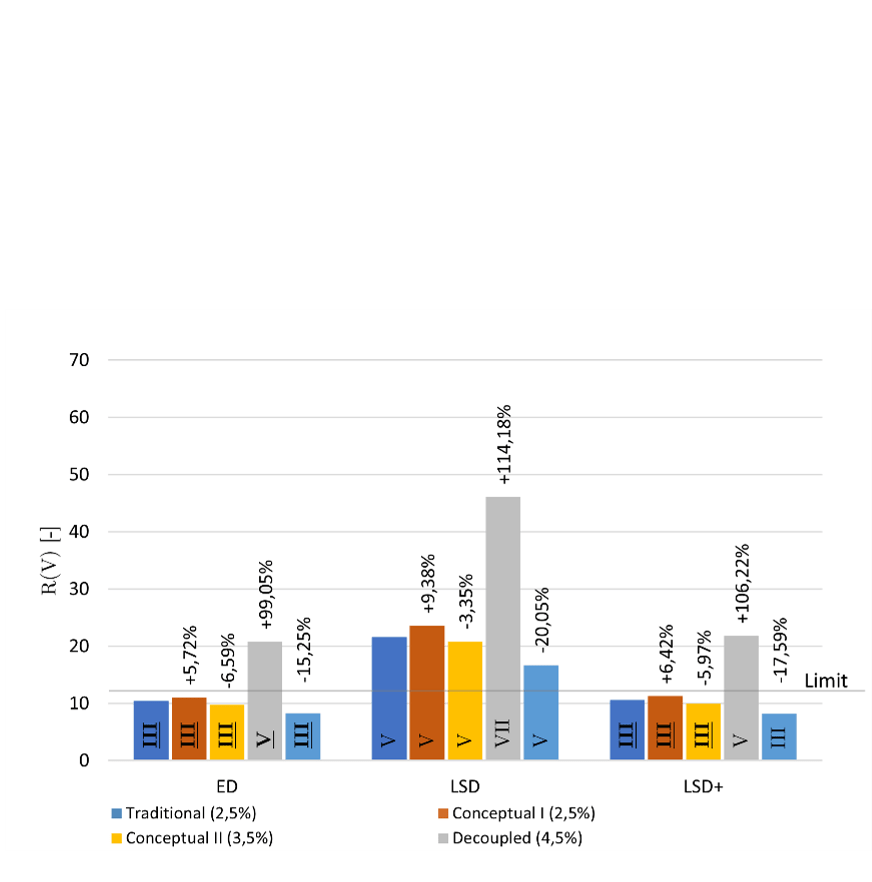
Overall a clear difference between the three sets of floors can be seen. The ED floors have the highest natural frequencies due to its decreased span and thus low slenderness, while the LSD floors feature the lowest natural frequencies due to its high slenderness. It can also be observed that the conceptual floors feature a generally higher natural frequency then the traditional floors. Their decrease in effective stiffness is thus not as strong as its decrease in mass. While this is positive, the decrease in mass provides a worse response factor. However, even though the conceptual floors with increased damping showed more positive results, the impact was overall not large enough to bring the floors in a lower vibration class.
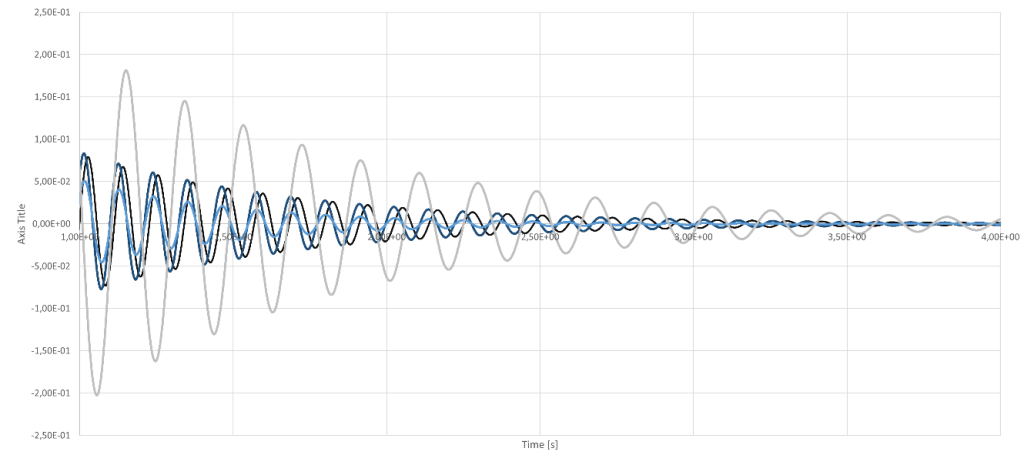
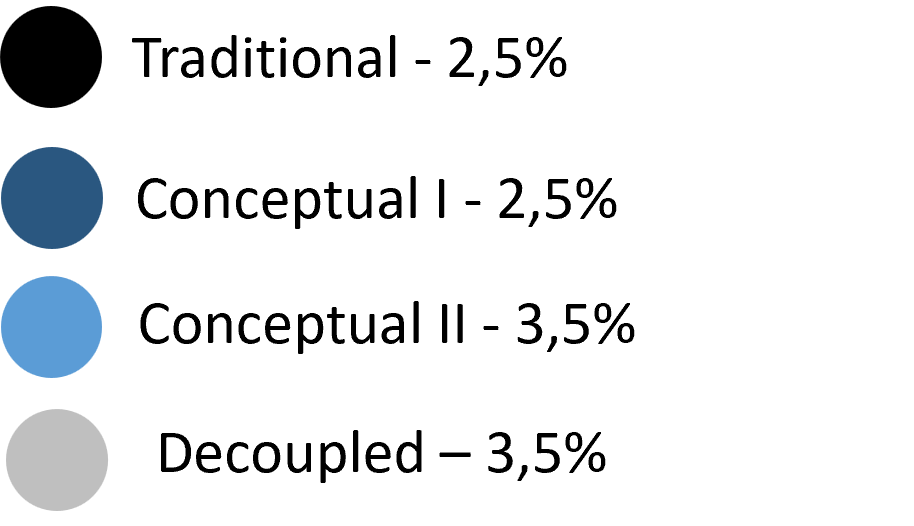
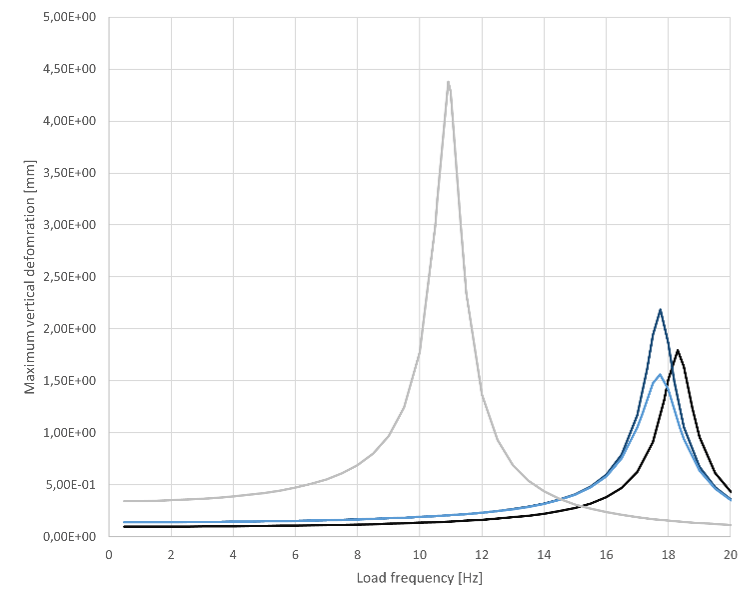
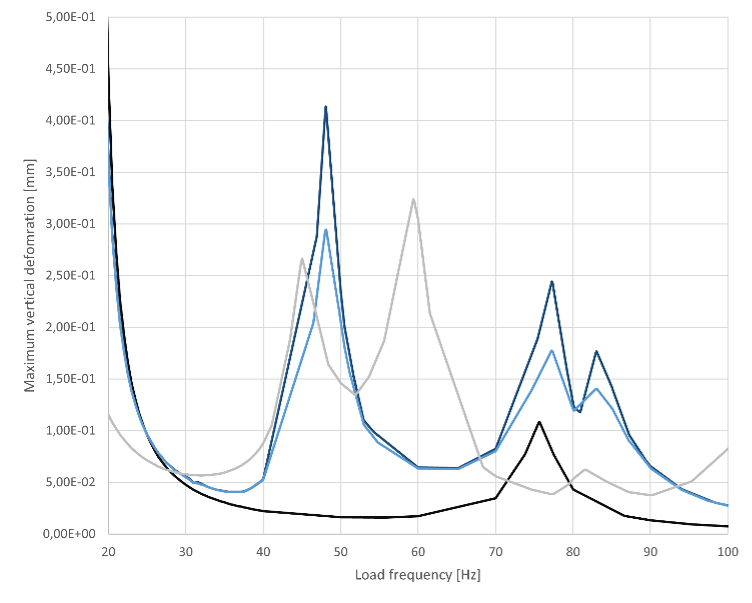
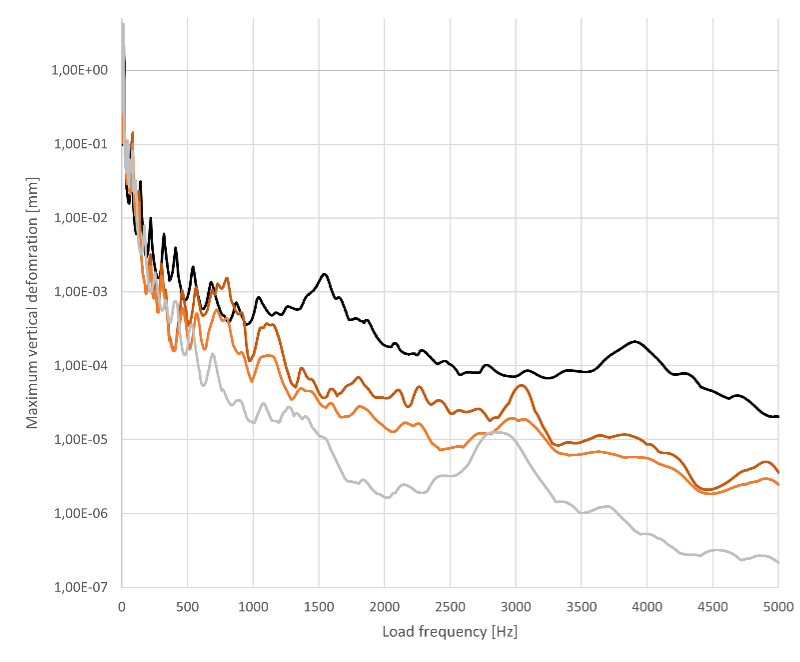
Secondly, using a 2D FEM model the system was numerically investigated. Firstly, a transient response analysis, calculating the response of the system over time, shows a similar amplitude as the traditional floor for the conceptual floor with 2,5% damping while the one with 3,5% damping shows a better result again. The Harmonic Response Analysis loads the system with cycling loads with varying frequencies. The graph shows the amplitude of the system for each of these cyclic loads and thus also shows its natural frequencies. Similarly to the analytical results, the first natural frequency of the floors (except for the less stiff decoupled one) are very close to each other. However, in higher frequencies, the conceptual floors features additional peaks similar to the decoupled floor.
At last, a ball fall test was done on the experimental specimens. Acceleration sensors on the specimens register the floor response and allow to find the first natural frequency and its damping coefficient. While in this investigation the natural frequency of the conceptual floor was lower then the one of the traditional floor, the values are still very close to each other. A larger difference is noticed in the damping, which is for the traditional floor only slightly higher then anticipated while the one for the conceptual floor is much higher then anticipated. However, when inserted in the analytical approach, it shows that it does not effect the response factor in the applicable transient / velocity domain.
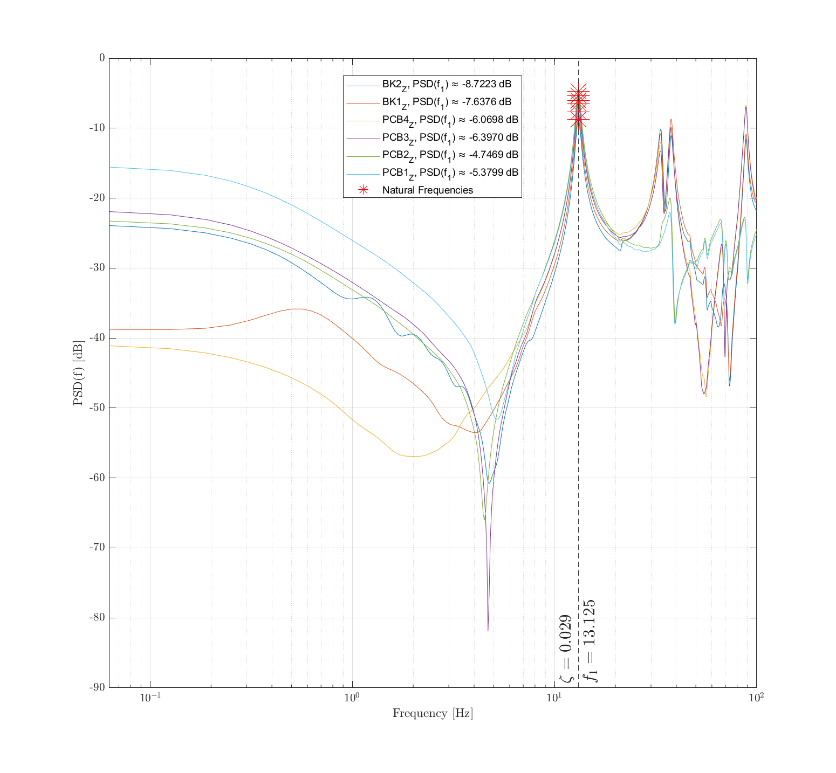
f1 = 13,25 Hz, ζ1 = 2,9%
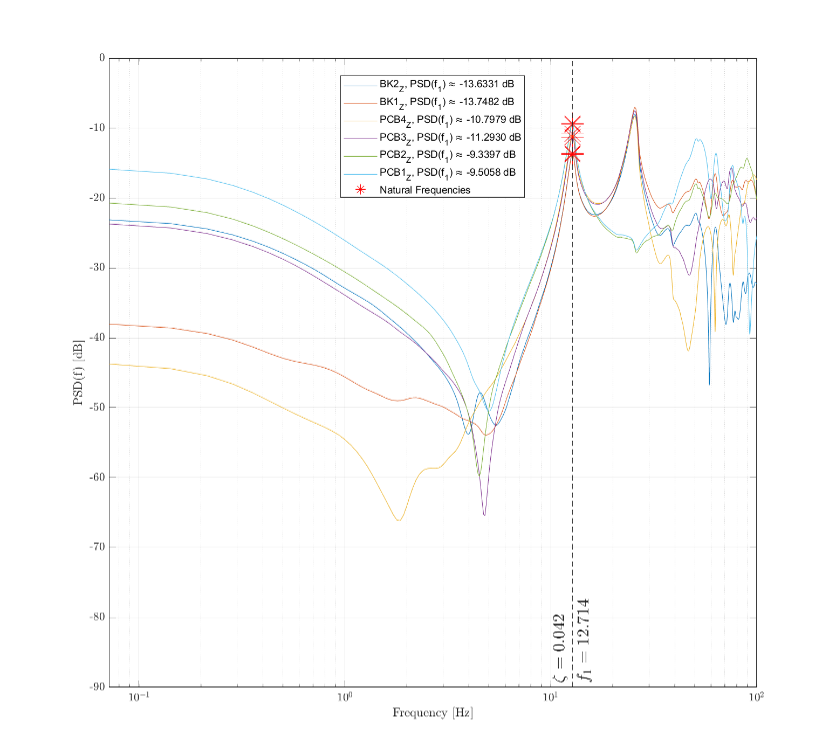
Conceptual floor
f1 = 12,72 Hz, ζ1 = 4,2%
Acoustic performance
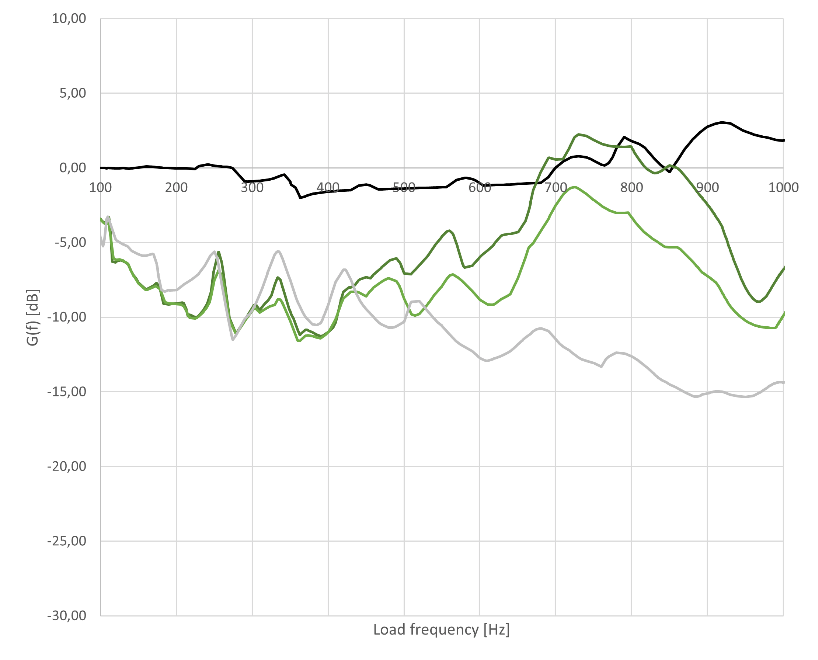
The acoustic performance of the floors were studied with a focus on the sound transmission of airborne- and impact sounds from the room above to the room below. This was done again using three approaches. The numerical approach used the same Harmonic Response Analysis described in the previous chapter. The results shown below for the full acoustic range show a general significant deviation of more then 5 dB between the response in the top concrete layer and the response in the bottom CLT layer. The observed behavior is more similar to the decoupled floor then to the traditional floor.
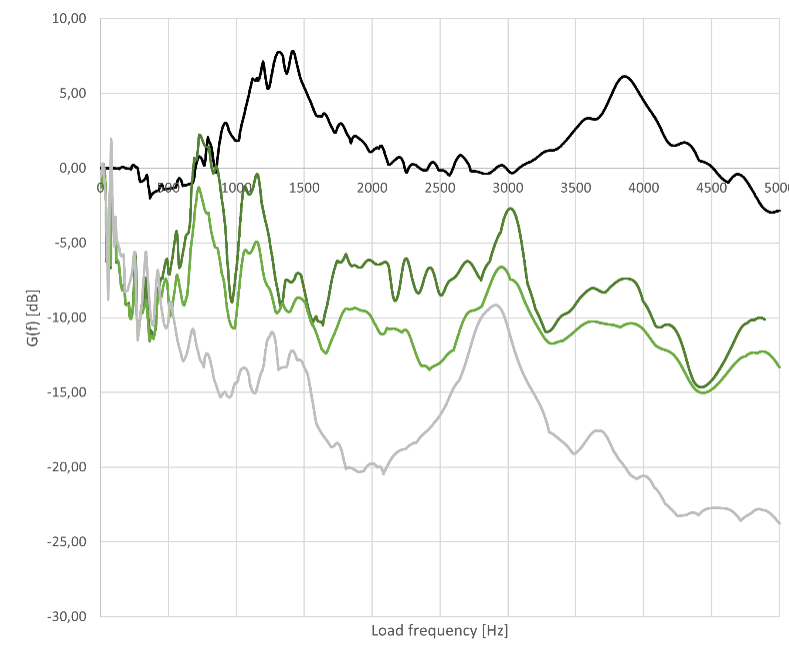
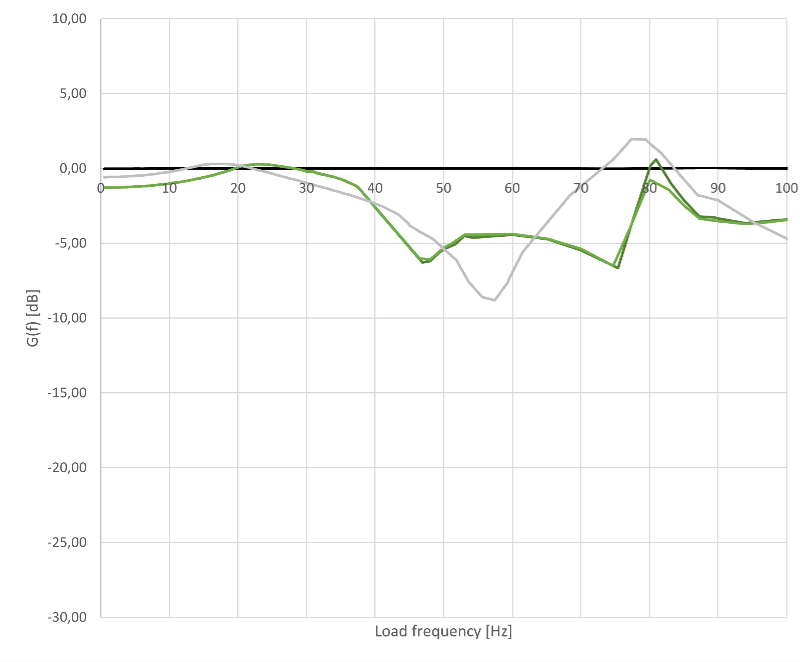
When zoomed into the critical lower frequencies, the expected constant nature of the traditional floor is clearly visible. For the initial frequencies this is, as expected, also the case for the decoupled and conceptual floors. However, between 30-80 Hz and between 100-600 Hz the first decoupling effects are observed. The positive ratio values mainly seen in the results of the traditional floor can be explained by the layered build-up of the CLT with weak transverse layers causing internal resonance while the concrete is unaffected.

Besides, the ball-fall test used in the vibration analysis was also used to provide an indication of the decoupling of the system. The experimental results shown below show a similar behavior for both floor types as compared to the numerical analysis. Although the ratio’s do not pass the 5dB, the first signs of decoupling in the conceptual floor are again observable from 30 Hz onwards. Besides, it is important to considere that in difference to the HRA these graphs are processed from an actual impuls, from which the response is expanded into the different (natural) frequenies and their share. The many observable positive peaks for the conceptual floor in the 100-1000 Hz could therefore be explained by a simple move in the ‘activated’ frequency. If for the concrete layer the 9 Hz mode has a large share in the response, while for the CLT layer it is the 10 Hz response, it shows a large positive and negative peak. The much more chaotic graph for the conceptual floor therefore tells us the dynamic behavior of the concrete and the CLT layer is different and thus not acting as a connected system. This is therefore also an indiciation of decoupling between the layers.
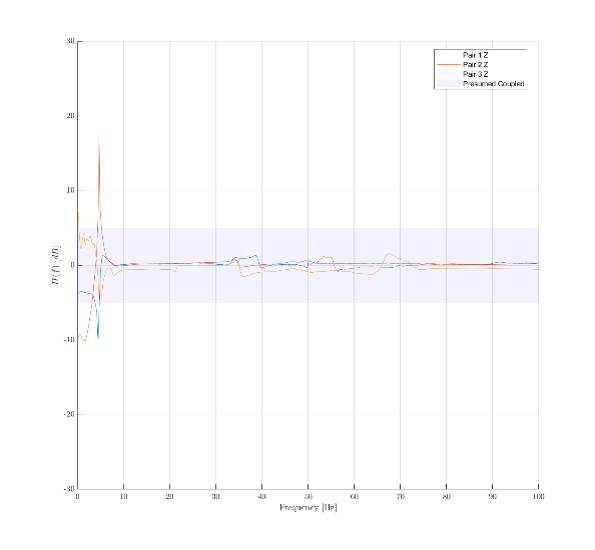
Ratios between the acceleration of top and bottom of the floor
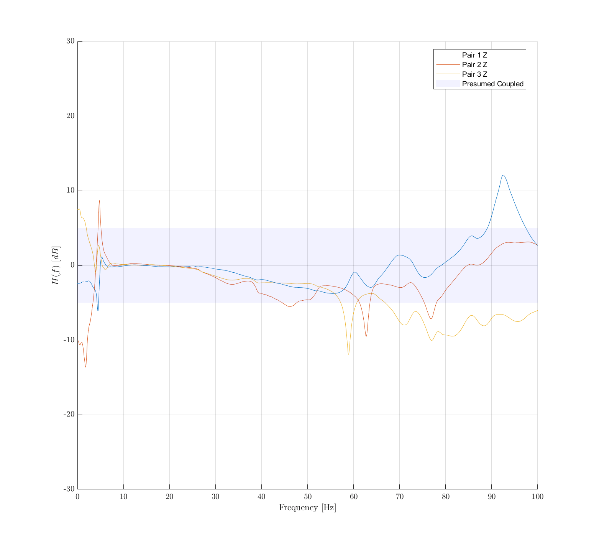
0-100 Hz
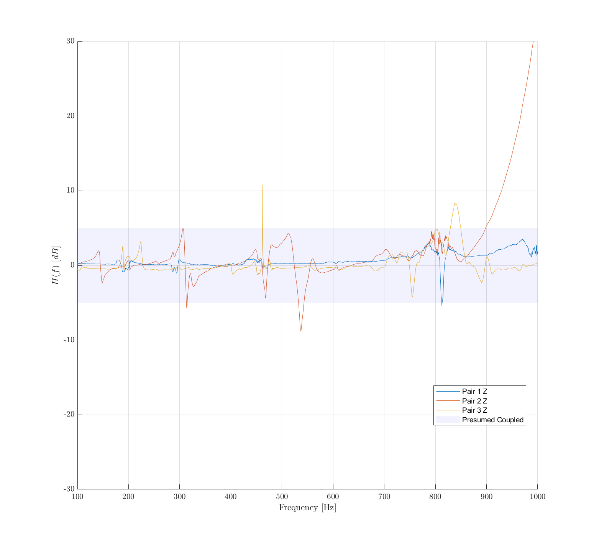
Ratios between the acceleration of top and bottom of the floor
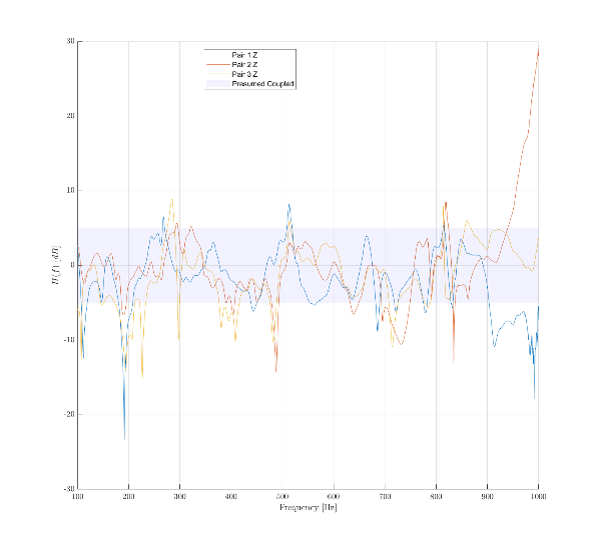
100-1000 Hz
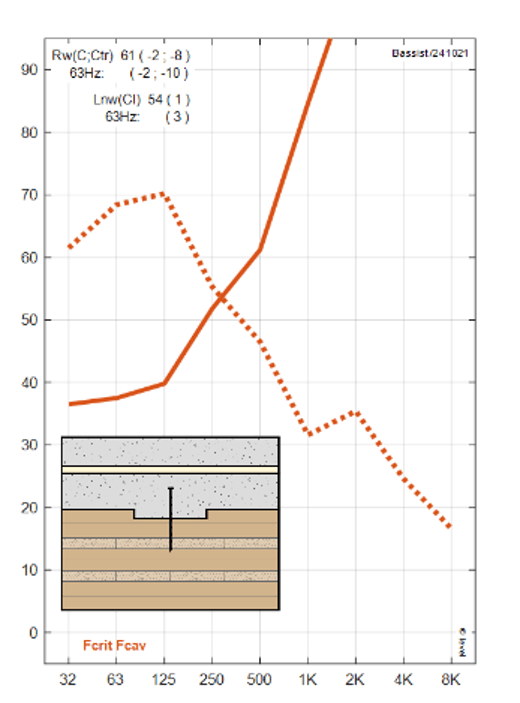
At last, an analytical approach using the software Bassist.Lab – 5.1 was used to provide an indication of the potential positive impact the decoupling could have. In the images below, the differences in behavior can clearly be observed. The decoupled systems show a large positive increase in airborne sound insulation DnT,A1 for mid- to high frequencies. For the impact sound pressure level LnT, A2 the behavior is again positive for mid- to high frequencies by decreasing significantly. However, for the critical frequency range between 40-125 Hz, it shows an increase in the impact sound impact value.
1 simplified: the amount of sound absorbed by the structure
2 simplified: the amount of sound measured in the room below
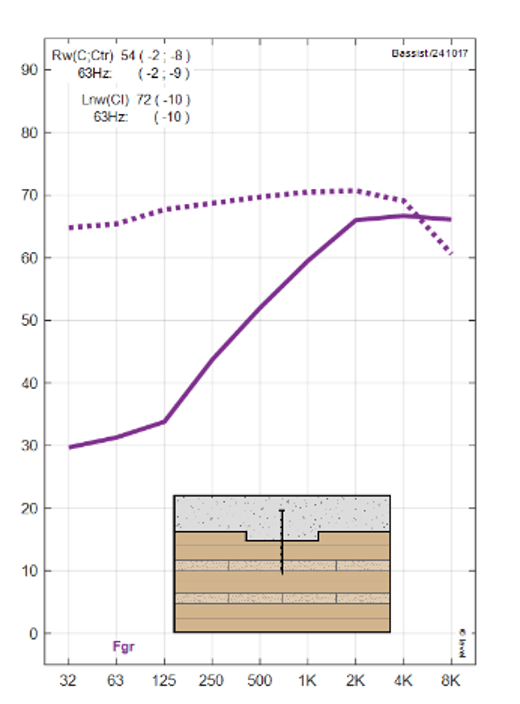
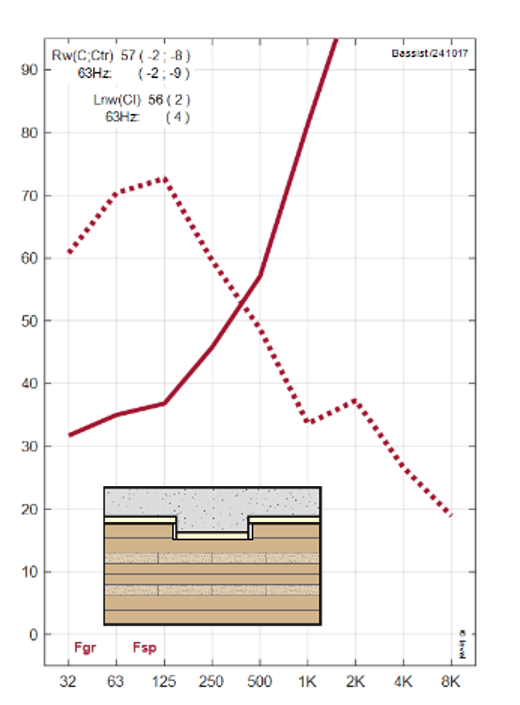
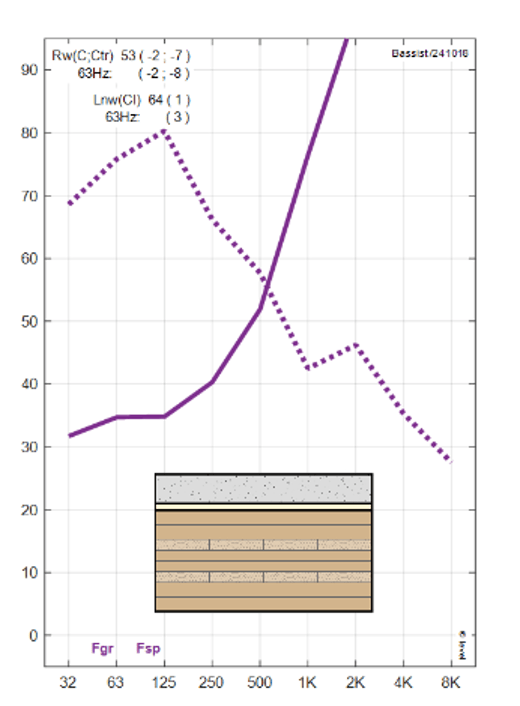
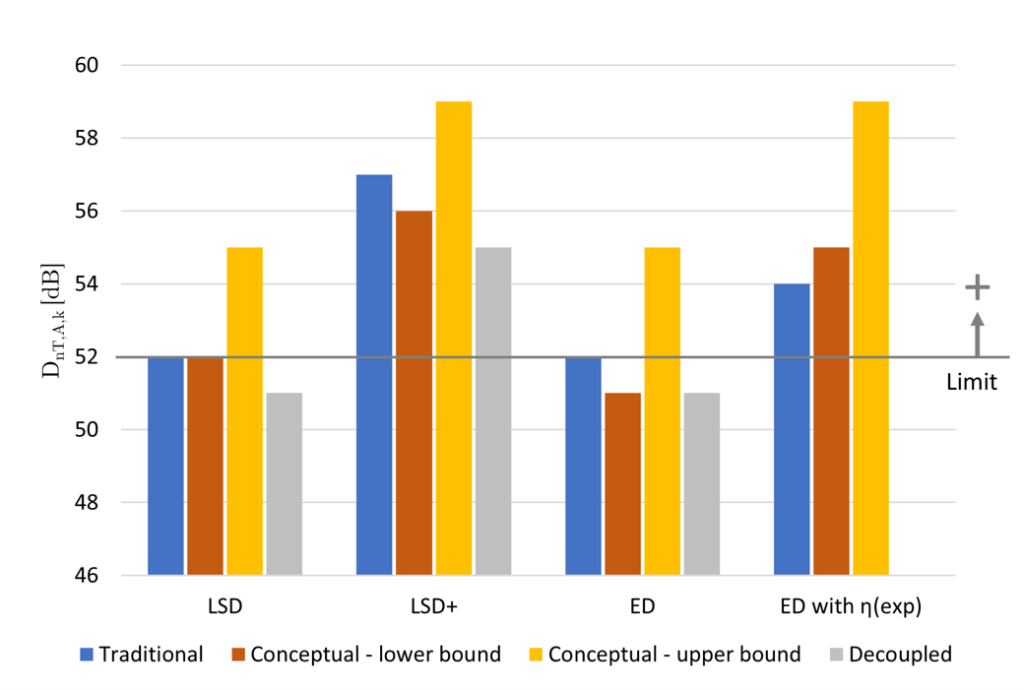
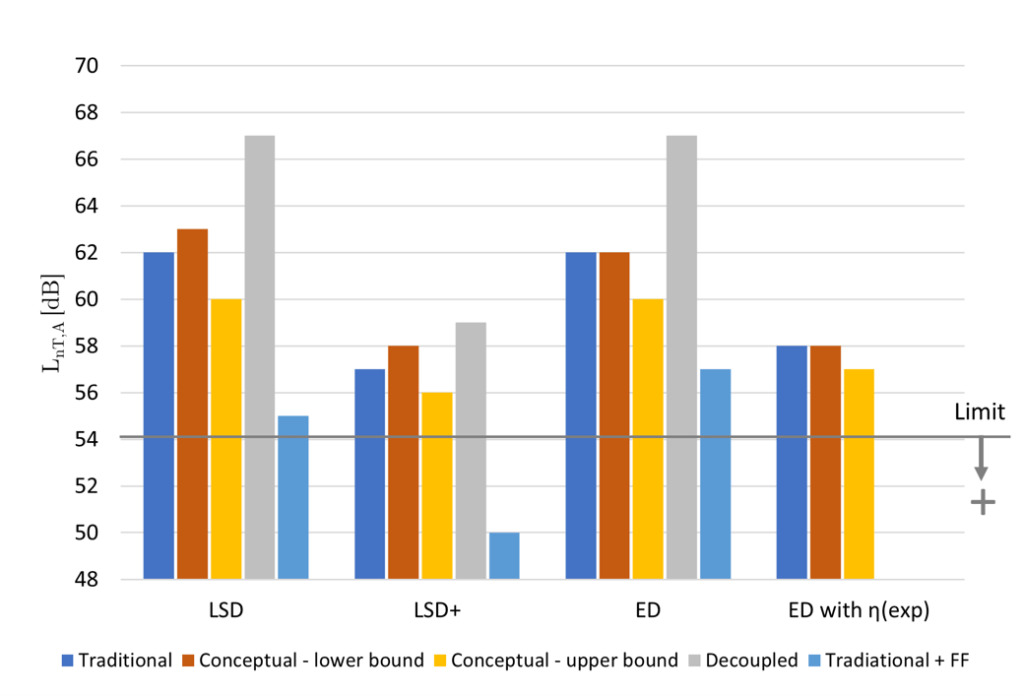
As done in practice, the behavior is summarized into one-number values based on the 63-8000 Hz range shown in the graphs below. In these graphs not only the conceptual floor modelled as a decoupled floor (Conceptual – upper bound) is shown, but also the conceptual floor modelled as a fully coupled floor is shown (Conceptual – lower bound). Where the latter shows very similar results to the traditional floor in behavior and one-number values, the upper bound shows a significant improvements for airborne sound insulation and small improvements in impact sound pressure level (due to the worse performance in the 63-125 Hz range).
Conclusion & Recommendations
The aim of this study was to explore the potential of integrating a resilient layer into a CLT-Concrete Composite floor to increase its vibration and acoustic performance while maintaining its structural efficiency.
The first part of the research investigating a wide rang of possible connector details showed that the detail featuring a rectangular notch without fastener showed the most promise.
Overall, the structural performance was mantained with only a small decrease in stiffness of approximately 10% compared to a traditional CCC floor, while also featuring a decreased amount of concrete and thus a decreased mass. For the structural Ultimate Limit State, it was found that the tested traditional floor did feature hairline cracks in the concrete around the notch, but did not fail at a load of 150 KN. The corresponding conceptual floor, did feature Concrete Diagonal Shear and progressive Timber shearing-off failures of the notches in the 140-148 kN domain, likely due to the lack of vertical reinforcement. While this is a brittle failure mode, the failure loads were considerably higher than the ULS loading conditions and thus do not impact the structural design significantly.
For the vibration performance it was observed from the experimental vibration fall-test that the conceptual floor features an approximate damping ratio of 4,2% while the traditional floor only features a damping ratio of 2,9%. Although this resulted in a overall increase of vibration performance for the conceptual floor, this was limited by its reduced bending stiffness and mass. The indicated increase in performance relative to the traditional floor could therefore not be judged as significant based on the used methods.
Based on the acoustic evaluation it was found that the decoupling effect was present in the conceptual floor and provided the conceptual and decoupled floor with a substantial increase of acoustic performance above 177 Hz, relative to the traditional floor. However the decoupling effect also introduced an extra critical mode in the 44-177 Hz region, which decreaed its impact sound performance LnT, A to a point where the improvement is minimal.
Overall, it can be said that the integration of Vibro-Acoustical resilient behaviour in CLT-Concrete Composite floors with resilient notched connections has much potential to increase the acoustic transmission performance, while replacing 20 mm of heavy concrete by 20 mm of light mineral wool and not requiring addition total floor height. However, since the vibration performance has to be assumed as equal to the traditional floors, the conceptual floors still have to feature the increased LSD+ dimensions to satisfy for vibration performance. Therefore, there is no significant dimension and material reduction in the structural floor itself. The main benefit of the system for the structural floor is therefore that the mass and concrete usage is significantly decreased. This can however still feature a considerable impact on the sustainability of a multi-residential buildings.
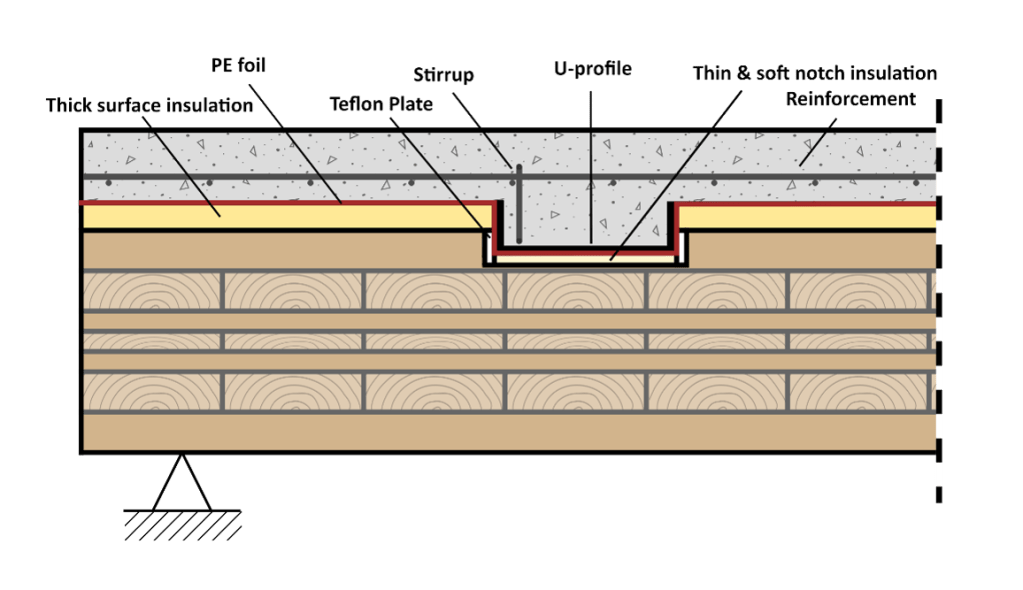
The total floor height, material and CO2 reduction could however be achieved when the full potential of the system in the low frequency 44-177 Hz domain is optimized and the required covering floors can be reduced. Further investigation on this topic, for example by variation in insulation ype and thickness on the surface and in the notch, could therefore provide valuable insights. Besides, it is recommended to further investigate and develop the design for practicial and high quality fabrication in combination with the uncertain and brittle connection failures. The image at the bottom shows an example of a further developed detail, including a U-profile for ease of production and stirrups for concrete reinforcement. At last, research into the moisture and shrinkage effects in the systems and detail and the integration of the floor in other building systems with different support conditions (such as 2-way spanning / 4-point support) can provide valuable insights into the applicability in practice and the connection integrity.
 RESED
RESED 